





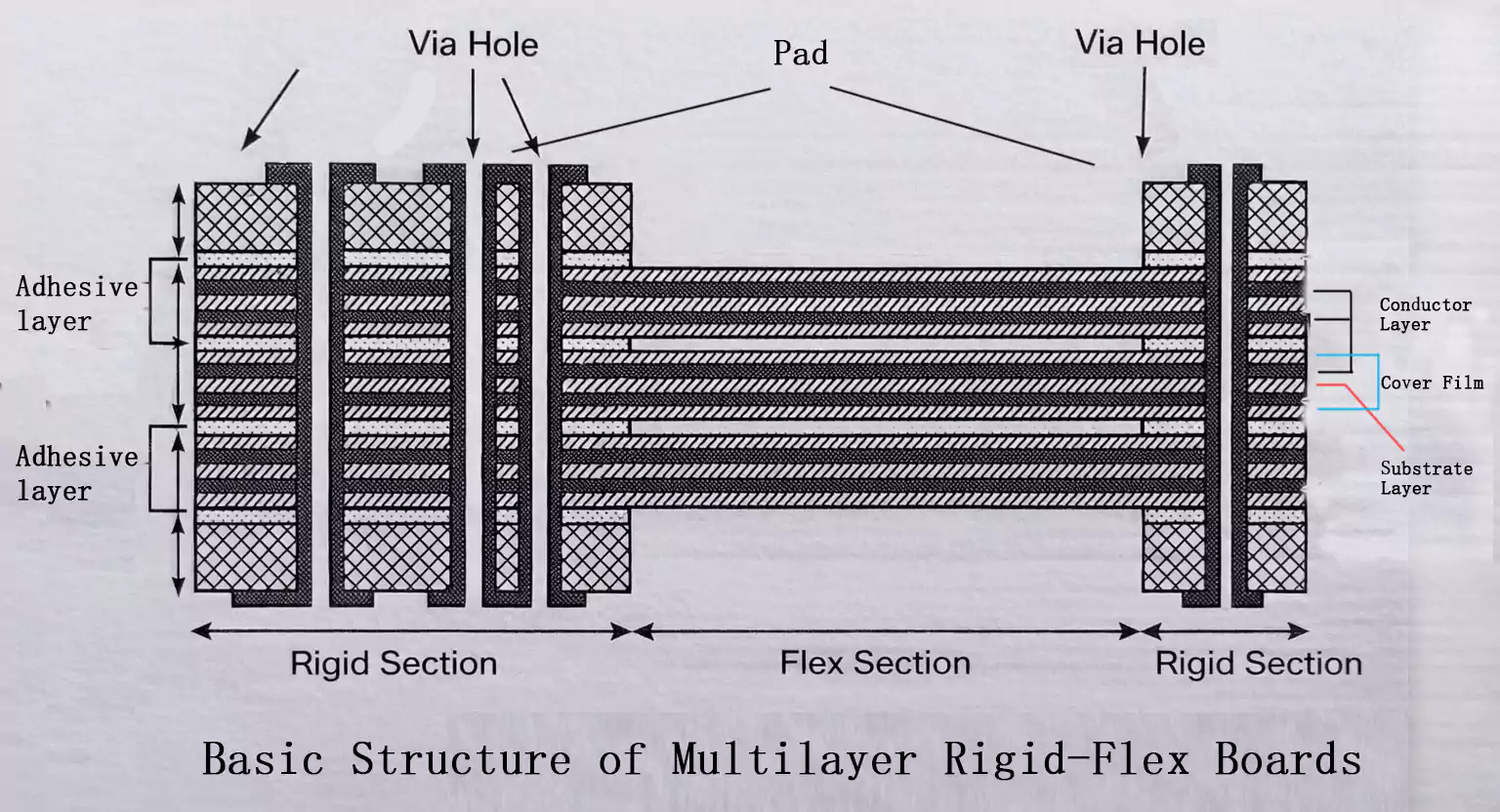

Choosing between a rigid PCB, a flex circuit, and a rigid flex PCB is a product design decision, not just a PCB selection exercise. The right choice affects packaging efficiency, mechanical reliability, assembly complexity, and total system cost.
Rigid PCBs are best for flat, stable designs. Flex PCBs are thin, lightweight, and ideal for bending or space-constrained layouts. Rigid Flex PCB combines rigid and flexible substrates into a single structure, giving designers greater 3D layout flexibility and improved interconnect reliability.
In general, flex circuits are better for continuous bending and maximum space savings, while rigid-flex designs offer stronger structural support for compact, high-reliability electronics. The tradeoff is that rigid-flex is typically more complex and more expensive to manufacture.
The key is not which technology is “better” in general, but which one fits your product’s mechanical and electrical requirements best.
Quick Answer: What Is the Main Difference?
The main difference lies in mechanical function and product architecture.
- Rigid PCB: best for flat, fixed, cost-sensitive designs
- Flex PCB: best for bending, folding, and lightweight packaging
- Rigid Flex PCB: best for compact, high-reliability products that need both structure and flexibility
A pure flex circuit is better for continuous or dynamic movement. A rigid-flex PCB provides stronger structural support and a more integrated layout for complex electronic assemblies.
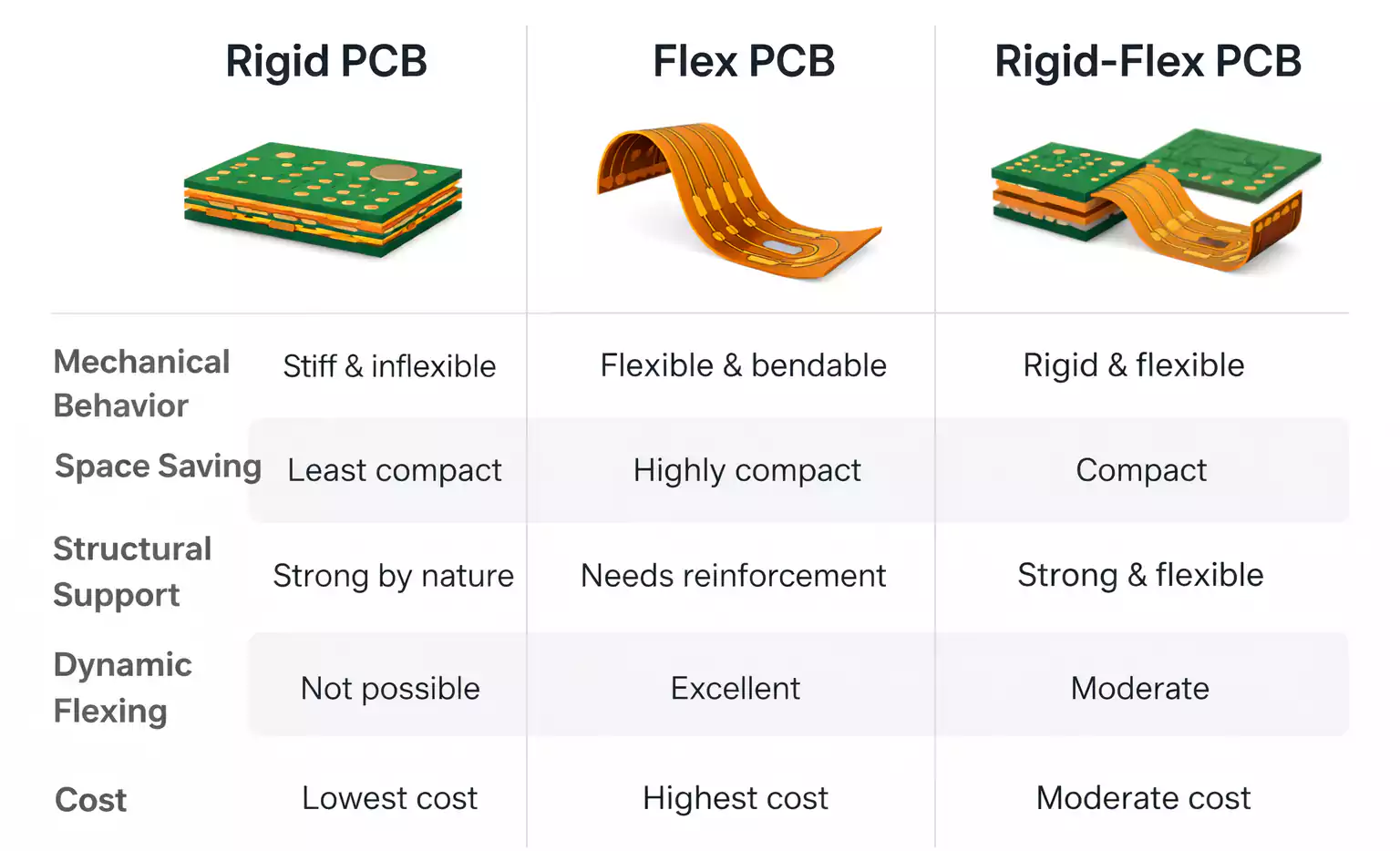
What Are Rigid, Flex, and Rigid Flex PCB?
Before comparing performance, it helps to define what each PCB type is designed to do.
What Is a Rigid PCB?
A rigid PCB is the standard circuit board used in most electronic products. It is built on solid substrate materials that do not bend after fabrication.
Rigid boards remain popular because they are:
- dimensionally stable
- relatively low cost
- easy to assemble
- well-suited to standard enclosure designs
They work best in products where the board stays fixed in place and does not need to flex during assembly or operation.
What Is a Flex PCB?
A flex PCB is built on flexible materials, such as polyimide, rather than a rigid substrate. This allows the circuit to bend, fold, and fit into tight or irregular spaces.
Flex circuits are commonly used when a product needs:
- reduced weight
- smaller packaging volume
- better vibration resistance
- static or dynamic bending
They are often used in compact electronics, medical devices, cameras, and products with moving mechanical sections.
What Is a Rigid Flex PCB?
A rigid flex PCB combines rigid and flexible sections into a single integrated circuit structure.
This gives the design both:
- rigid areas for component mounting
- flexible areas for folding and interconnection
It can also reduce the need for separate connectors and cable assemblies while improving packaging efficiency in compact 3D layouts.
Rigid-flex is typically used when a product needs both mechanical support and space-saving internal interconnection.
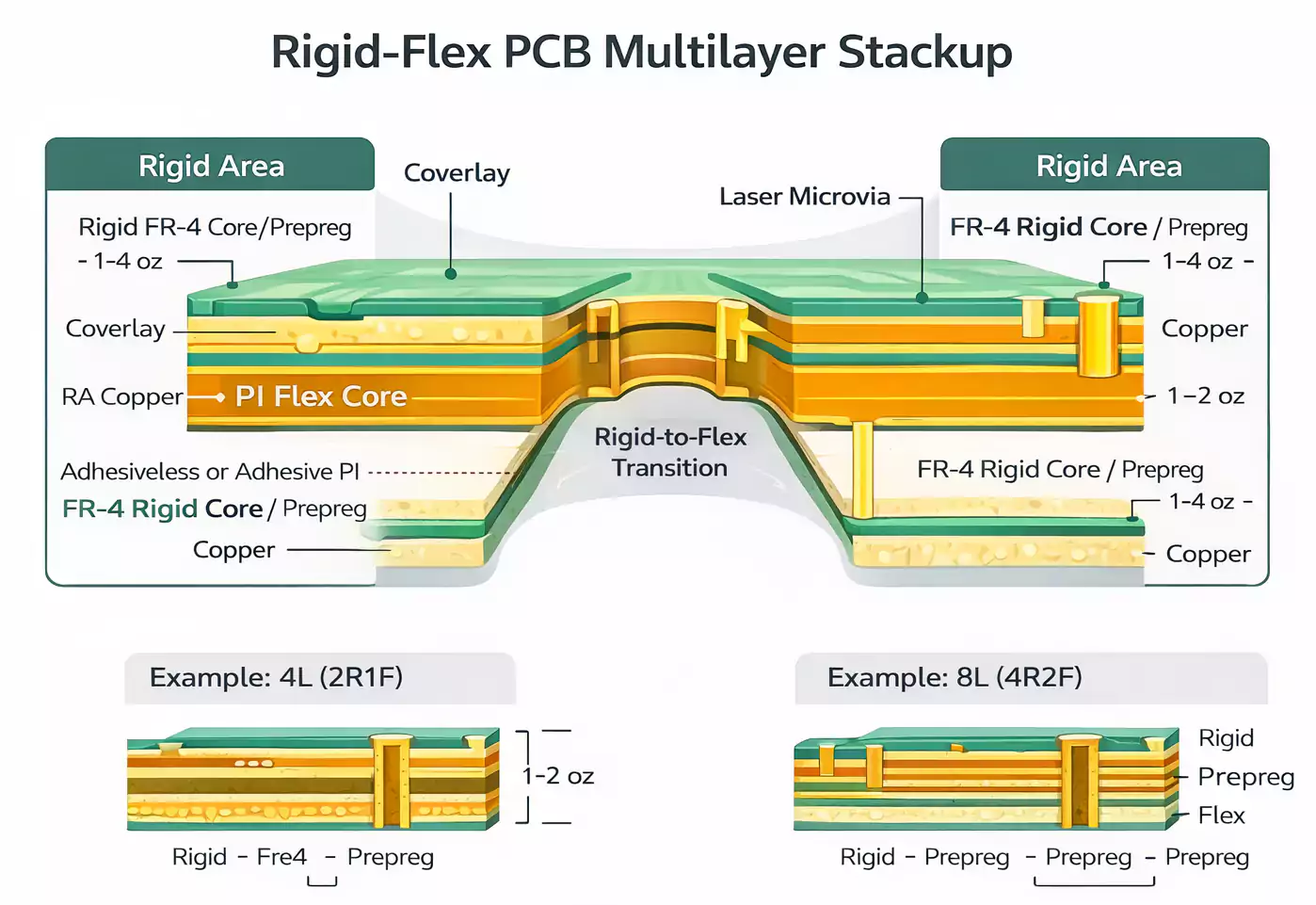
Rigid vs. Flex vs. Rigid-Flex: Key Differences at a Glance
The easiest way to compare these technologies is side-by-side.
| Mechanical behavior | Fixed and stiff | Bendable | Part rigid, part bendable |
| Space saving | Low | High | Very high |
| Structural support | High | Low | High in rigid areas |
| Dynamic flexing | Poor | Excellent | Limited to flex sections |
| Assembly complexity | Low for simple products | Moderate | Lower at system level when connectors are removed |
| Connector reduction | Low | Moderate | High |
| Bare board cost | Lowest | Higher | Highest |
| System-level cost potential | Good | Good | Often best in compact multi-board products |
| Best use case | Standard electronics | Lightweight or moving designs | Compact, high-reliability assemblies |
This comparison shows why board price alone does not tell the full story. In many products, the option with the highest fabrication cost can still deliver the lowest total system cost.
Why the Choice Matters at the Product Level
Many teams compare PCB types solely on bare-board price. That often leads to the wrong decision.
A better question is this:
Which option creates the fewest compromises in the final product?
At the product level, four factors usually matter most:
- space utilization
- reliability
- assembly complexity
- total cost
Each one can shift the decision in a different direction.
1. Space Utilization
Rigid boards require flat mounting space. In simple products with roomy enclosures, that is usually not a problem.
But when a design becomes compact, folded, stacked, or mechanically constrained, rigid boards can limit the overall package.
Flex and rigid-flex both improve space efficiency because they can route through bends, corners, and tight internal geometries.
Rigid-flex becomes especially useful when:
- Multiple board areas must fit inside a small enclosure
- The design includes a hinge or fold
- A 3D layout is required
- separate boards and cables can be replaced with one integrated structure
In compact products, that is often where rigid-flex begins to outperform both rigid-only and flex-only designs.
2. Reliability
Reliability depends on the type of mechanical stress the product must handle.
Rigid PCB Reliability
Rigid boards are highly reliable in fixed, low-stress environments. They are stable, simple, and well understood in manufacturing.
Flex PCB Reliability
Flex circuits are well-suited to designs that involve repeated bending, movement, or vibration. When designed correctly, they can survive continuous flexing better than rigid alternatives.
Rigid Flex PCB Reliability
Rigid-flex performs best when reliability issues are caused by connector, cable, or interconnect failures rather than by constant motion.
That is why rigid-flex is often used in:
- medical devices
- aerospace electronics
- rugged industrial systems
- compact wearables
In these products, fewer connectors often means fewer field failures.
3. Assembly Complexity
A rigid board may seem like the simplest option at first. But that changes once a product uses multiple rigid boards connected by wires, ribbon cables, or board-to-board connectors.
Each additional interconnect introduces:
- more parts to source
- more assembly steps
- more tolerance stack-up
- more opportunities for failure
A rigid-flex PCB may be more complex to fabricate, but it can be much simpler to assemble at the product level because the interconnect is already built into the board.
That is one of the main reasons engineers choose rigid-flex in compact, high-reliability applications.
4. Cost: Unit Cost vs. Total Cost
This is where many design decisions go wrong.
Yes, rigid-flex usually has a higher bare board cost. That is because it often requires:
- specialized materials
- more complex lamination
- tighter process control
- more difficult fabrication and inspection
But the bare board cost is only one part of the total cost equation.
In many products, rigid-flex can reduce overall system cost by lowering:
- connector count
- cable and harness usage
- manual assembly labor
- rework and maintenance risk
- packaging complexity
Why Connector-Less Design Matters
One of the biggest advantages of rigid-flex is that it can simplify the entire system architecture.
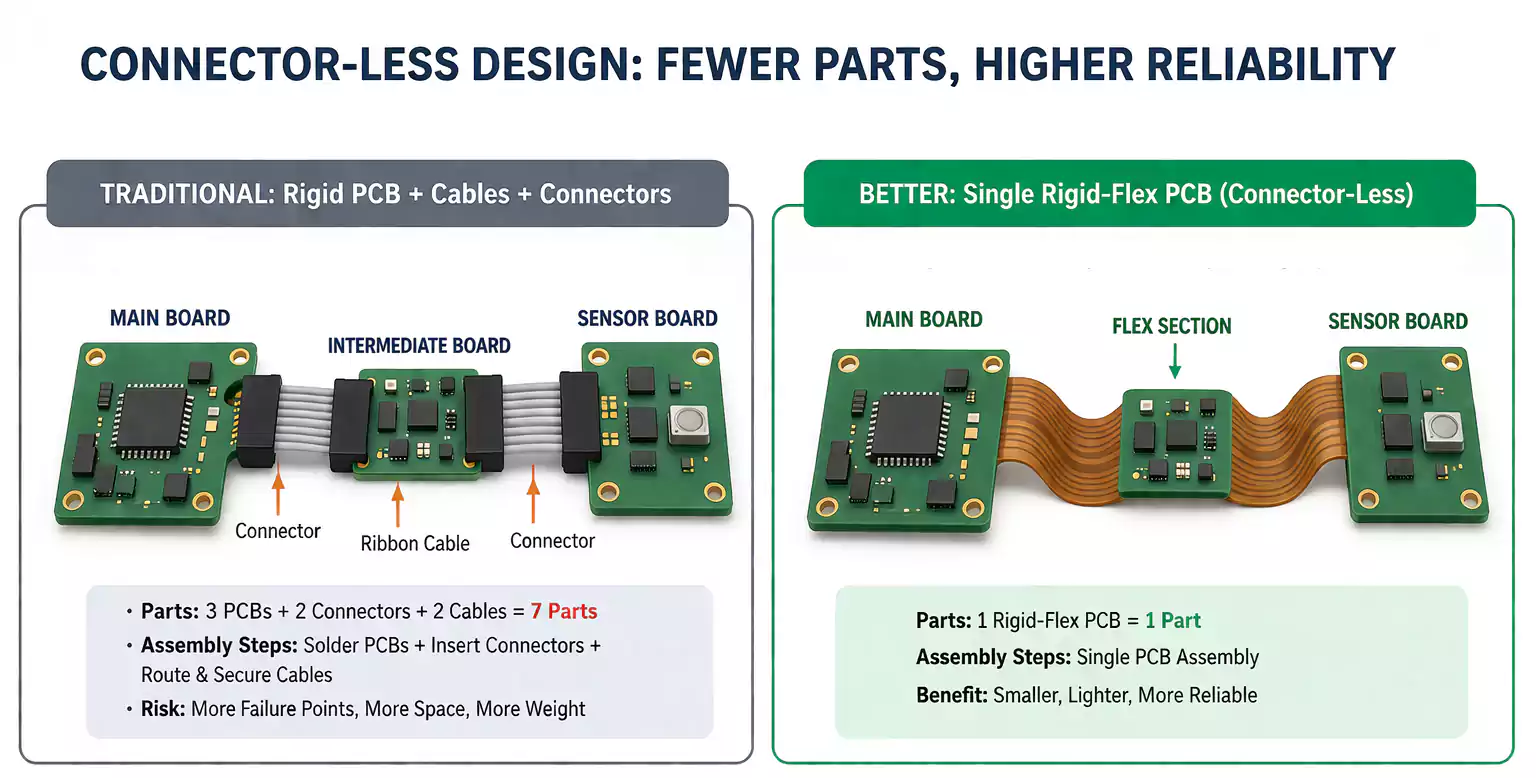
In a traditional design, a product may use:
- multiple rigid PCBs
- ribbon cables
- wire harnesses
- board-to-board connectors
That approach works, but it adds extra mechanical and electrical interfaces. Each connector is a potential failure point. Each cable adds bulk. Each assembly step adds labor and variation.
Rigid-flex reduces that complexity by integrating the interconnect directly into the PCB structure.
Benefits of a connector-reduced design
- less internal clutter
- fewer BOM items
- lower assembly labor
- lower risk of contact failure
- better resistance to shock and vibration
- cleaner internal routing
That is why rigid-flex often makes the most sense in products where reliability and space matter more than the lowest possible board price.
When a Rigid PCB Is the Best Choice
A rigid PCB is usually the right starting point when the design is straightforward and cost-sensitive.
Choose a rigid PCB when your product has:
- enough internal space
- a flat board layout
- no need for bending or folding
- low packaging complexity
- standard manufacturing priorities
Rigid remains the default choice for a wide range of electronics because it is simple, proven, and economical.

When a Flex PCB Is the Best Choice
A pure flex circuit is often the better option when movement is part of the design.
Choose a flex PCB when your product needs:
- repeated bending
- very low weight
- minimal thickness
- routing through unusual shapes
- better fit in moving assemblies
Flex is especially effective when the circuit itself must move during normal operation.
That includes products with hinges, folding mechanisms, rotating sections, or tight spaces that cannot accommodate traditional rigid boards.
When a Rigid Flex PCB Is the Best Choice
Rigid-flex becomes the strongest option when a product needs both structural support and flexible interconnection.
Choose rigid-flex when you need:
- rigid component mounting areas
- flexible interconnect between board sections
- fewer connectors
- smaller overall product size
- better reliability in high-vibration environments
- a cleaner 3D internal layout
Rigid-flex is often worth the higher board cost when connector reduction, packaging efficiency, and long-term reliability are priorities.
Common Misconceptions About Rigid Flex PCB
“Rigid-flex is always too expensive.”
Not necessarily.
Rigid-flex usually costs more at the bare board level, but it can lower total product cost by simplifying assembly and eliminating connectors and cables.
“Flex can always replace rigid-flex.”
Not always.
A flex circuit can solve many packaging problems, but it does not provide the same rigid mounting support or integrated board-to-board structure as a rigid-flex design.
“Connectors are a small issue.”
In compact or high-reliability products, connectors are often a major issue.
They take up space, add cost, increase labor, and create more failure points.
Typical Applications
Consumer Electronics
Rigid-flex is often used in compact consumer products where internal space is limited, and multiple board sections must fit into a small housing.
Medical Devices
Flex and rigid-flex are widely used in wearables, imaging systems, and compact handheld medical electronics because of their size and reliability advantages.
Aerospace and Defense
Rigid-flex is valued in harsh environments where vibration resistance, weight reduction, and connector elimination improve reliability.
Industrial Systems
In rugged industrial equipment, rigid-flex can reduce interconnect failure and improve packaging flexibility in dense assemblies.
FAQ
What is the difference between rigid-flex and flexible PCB?
A flexible PCB uses only flexible materials and is best for bending or movement. A rigid-flex PCB combines rigid and flexible sections into a single board, providing both structural support and flexible interconnects.
Is rigid-flex better than rigid PCB?
It depends on the application. Rigid-flex is better for compact, high-reliability, multi-zone designs. A rigid PCB is usually better for simple, cost-sensitive products with enough space.
Why are rigid-flex PCBs expensive?
They require specialized materials, more complex fabrication, and tighter process control. However, they can reduce total system cost by eliminating connectors and simplifying assembly.
When should rigid-flex PCBs be used?
They should be used when a product needs both rigid component support and flexible interconnection, especially in space-constrained or high-reliability applications.
Final Thoughts
There is no universal answer to the rigid vs. flex vs. rigid-flex question. Each option solves a different set of design challenges.
Rigid PCBs are the practical choice for simple, cost-driven products. Flex circuits are better suited to thin, bendable, and space-constrained designs. Rigid Flex PCB makes the most sense when a product requires both structural support and compact, reliable interconnection.
The right choice depends on how the product must fit, function, and perform over time.
At FastTurnPCB, we view PCB selection as a balance between space, reliability, manufacturability, and cost. Choosing the right architecture early helps create a more efficient and reliable design from the start.