


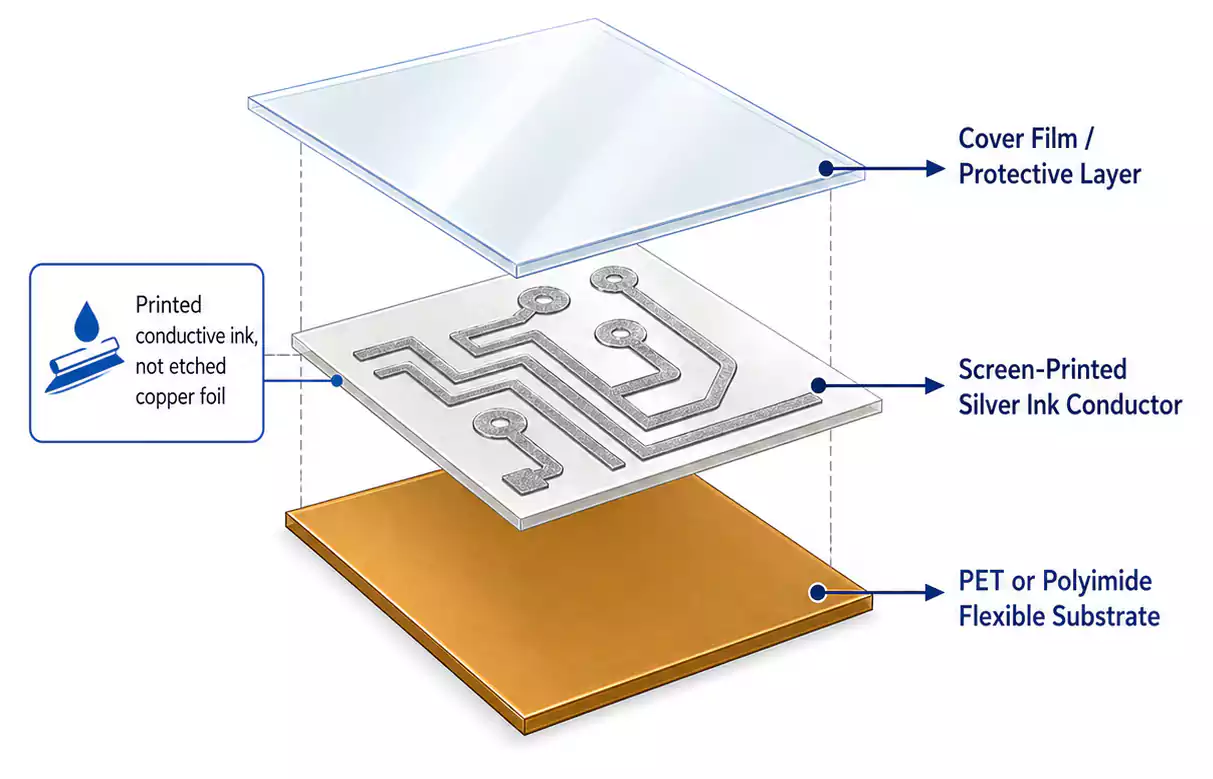
A polymer thick film (PTF) flex circuit is a lightweight, low-cost flexible circuit made by screen printing conductive ink onto a flexible polymer substrate, such as PET or polyimide.
Unlike traditional copper flex PCBs, PTF flex circuits use additive printing rather than copper etching. Silver ink is the most common conductor, although carbon and copper pastes may also be used for specific low-cost applications.
Because they are thin, flexible, and easy to produce in large volumes, polymer thick-film flex circuits are widely used in membrane switches, keypad circuits, touch switches, and other low-power flexible electronic interfaces.
What Is a Polymer Thick Film Flex Circuit?
A polymer thick film flex circuit is a flexible printed circuit in which the conductive traces are formed by printing conductive paste onto a flexible film substrate.
The basic process is simple:
- Conductive paste is screen printed onto the base film.
- The printed pattern is baked and cured.
- A cover film may be laminated over the circuit.
- The final circuit is cut to shape.
Common conductive materials include silver paste, copper paste, and carbon paste. Among them, screen-printed silver ink is the most widely used option because it provides better conductivity than carbon paste and is suitable for many low-current applications.
Compared with traditional copper flex PCBs, polymer thick film flex circuits are usually lower in cost, easier to manufacture in high volume, and well-suited for roll-to-roll production. However, their electrical performance is generally lower than that of copper-foil flexible circuits.
Common Materials Used in Thick-Film Flex Circuits
The performance of a thick-film conductor flex PCB depends mainly on two material groups:
- Flexible substrate
- Conductive paste
The selection of these materials affects cost, conductivity, heat resistance, dimensional stability, and the final application range.
Flexible Substrate Materials
Common substrate materials include:
- PET polyester film
- Polyimide film
- Polyacrylic resin film
PET Film
PET flexible circuit structures are widely used because PET film is inexpensive, flexible, and suitable for high-volume production. When PET film is combined with screen-printed silver ink, the total manufacturing cost can be significantly reduced.
PET film can also be transparent, making it useful for certain touch-switch and display-related applications.
However, PET has limited heat resistance. It usually cannot withstand the temperatures used in standard PCB soldering processes. For this reason, PET-based polymer thick film flex circuits are not suitable for many conventional solder assembly processes.
Polyimide Film
Polyimide offers better thermal stability than PET and is widely used in flexible PCB manufacturing. When combined with printed conductive paste, it can support more demanding applications than low-cost polyester films.
However, the final performance still depends on the conductive paste, curing process, and required electrical properties.
Polyacrylic Resin Film
Polyacrylic resin can also be used as a base material for thick-film conductor flex PCBs. However, if the circuit is fabricated on this type of substrate, it cannot generally be soldered using standard methods.
This limits its use in applications that require conventional PCB assembly.
Conductive Paste Materials
Polymer thick-film flex circuits can use several types of conductive paste, including silver, copper, and carbon pastes.
Silver Paste Conductors
A silver-paste flexible circuit is one of the most common types of polymer-thick-film flex circuits.
Silver paste behaves somewhat like ink. It can be applied to the substrate by screen printing. After printing, the pattern is baked and cured at a controlled temperature. A cover film can then be laminated over the printed traces to protect the circuit.
A screen-printed silver ink flexible circuit offers several advantages:
- Mature manufacturing process
- Good printability
- Better conductivity than carbon paste
- Suitable for low-current circuits
- Good choice for membrane switches and keypad circuits
- Suitable for high-volume production
However, silver paste does not provide the same conductivity as copper foil. For this reason, it is not suitable for power circuits, high-current paths, or high-speed signal layers.
Copper Paste Conductors
Copper paste can also be used as a conductive material in thick-film flex PCBs. It is relatively low-cost, but its conductivity and long-term stability are usually not as strong as those of traditional copper foil conductors.
Because of these limitations, copper paste has a narrower application range. It is generally not used when the circuit requires high conductivity, tight electrical consistency, or high reliability.
Carbon Paste Conductors
Carbon paste is another low-cost conductor option. It is inexpensive, but its conductivity is poor, and its electrical stability is limited.
Carbon paste may be used for simple conductive areas, low-cost contact structures, or certain resistive features. However, it is not suitable for circuits that require stable resistance, strong conductivity, or reliable signal transmission.
Main Applications of Polymer Thick Film Flex Circuits
The main advantage of a polymer thick-film flex circuit is its low-cost production. As a result, it is mostly used in products with low current, low signal speed, and relatively large circuit areas.
Membrane Switch Flex Circuits
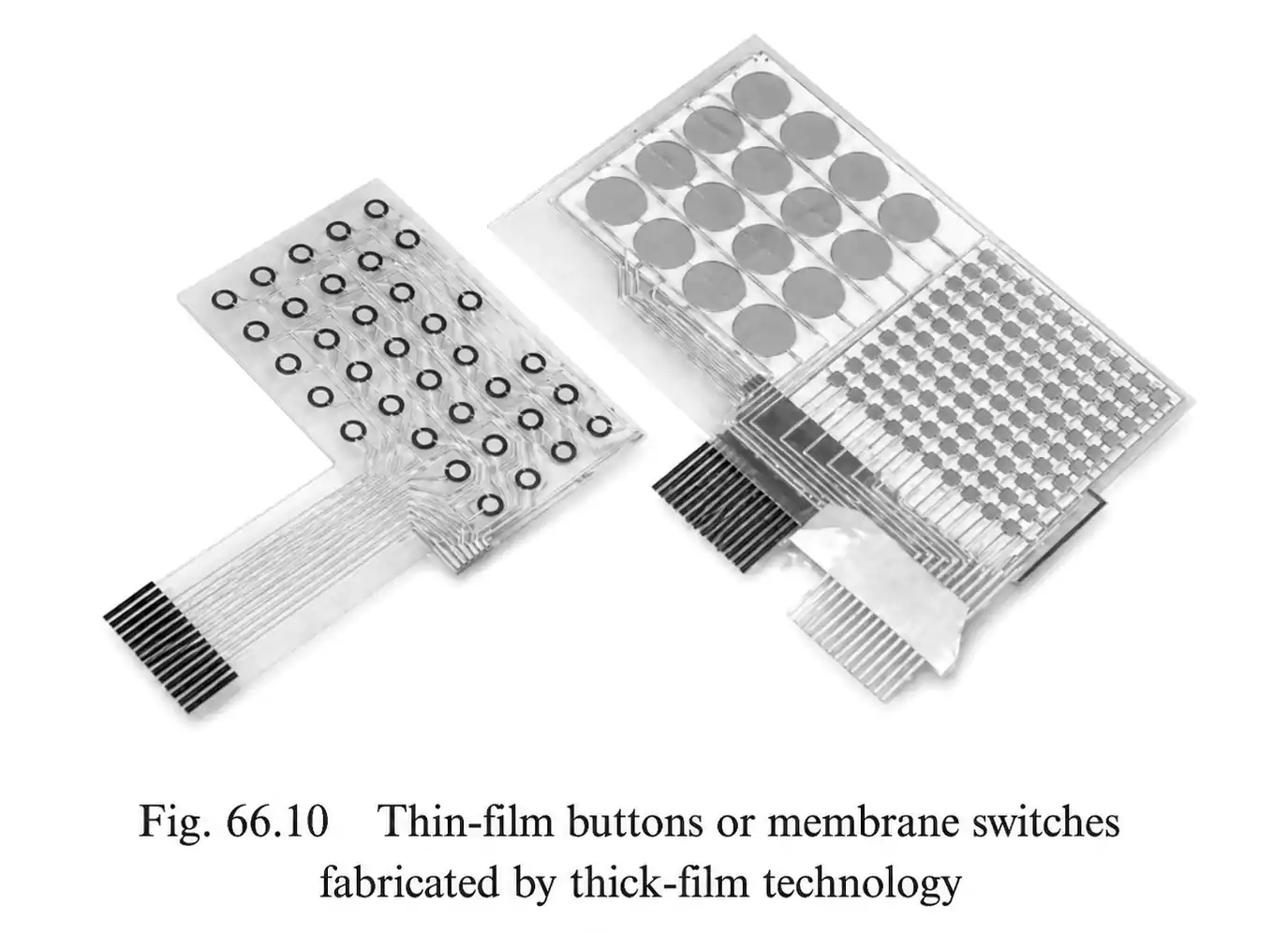
The largest application for thick-film conductor flex PCBs is the membrane switch flex circuit.
Membrane switches and membrane keypads usually require a relatively large circuit area, but the actual load current is very small. Because electrical requirements are less demanding than those for power or high-speed circuits, screen-printed silver ink is often an economical and practical solution.
Common applications include:
- Microwave oven control panels
- Office equipment keypads
- Medical device control panels
- Industrial control switches
- Consumer electronics interfaces
Most membrane switches are made with PET film because PET is inexpensive, easy to process, and suitable for high-volume manufacturing.
Transparent Touch Switches
PET-based thick-film flex circuits can be transparent, so they have also been used in touch switch structures for electronic products.
In some portable devices, such as PDAs and other handheld electronics, transparent PET thick-film circuits were used as touch switch interfaces. These circuits provided a thin, lightweight, and low-cost way to create flexible input functions.
Low-Cost Flexible Electronics
Polymer thick-film technology is also useful in certain printed electronics flexible-circuit applications. Because the process is based on printing rather than copper etching, it can reduce process complexity and support efficient volume production.
For products that require simple interconnection, flexible input interfaces, or low-current conductive patterns, a polymer thick-film flex circuit can be a practical, low-cost solution.
Applications Where Thick-Film Flex PCBs Are Not Suitable
Although thick-film conductor flex PCBs are cost-effective and easy to manufacture, they are not suitable for every type of circuit.
Because printed conductive paste has much lower conductivity than copper foil, thick-film flex circuits are generally not recommended for:
- Power circuits
- High-current traces
- High-speed signal layers
- High-frequency communication circuits
- Controlled-impedance traces
- Circuits that require standard soldering temperatures
The substrate also creates limitations. PET and polyacrylic resin films cannot usually withstand standard soldering temperatures, so they are not ideal for assemblies that require conventional PCB soldering.
Manufacturing Process of Polymer Thick Film Flex Circuits
The manufacturing process for a polymer thick-film flex circuit is simpler than that for a conventional copper-etched flexible PCB. It usually includes two main steps.
Step 1: Screen Print the Conductive Paste and Bake
First, the conductive paste is screen printed onto the flexible substrate. The paste may be silver, copper, carbon, or another functional conductive material.
After printing, the circuit is baked at a controlled temperature. This curing step solidifies the paste and forms the conductive pattern.
Although the process looks simple, process control is still very important. Flexible substrates can vary significantly with temperature, baking time, and processing conditions.
If polyester film is used as the substrate, pre-baking is often required. Pre-baking helps reduce shrinkage during the later curing process and improves dimensional stability.
Step 2: Cut the Circuit to Shape
After the printed conductor pattern is cured, the flex circuit is cut to its final shape.
Because the process is simple and uses fewer manufacturing steps, thick-film flex circuits are well-suited for roll-to-roll manufacturing. This makes them especially attractive for high-volume products such as membrane switches and low-cost flexible electronic circuits.
Fine-Line Development in Thick-Film Flex Circuits
As conductive paste and printing technology continue to improve, polymer thick film flex circuits can achieve much finer line patterns than before.
Newer processes can produce line pitches of approximately 10–15 μm at relatively low cost. This gives thick-film conductor flex PCBs potential in more compact flexible electronics and fine-line printed circuit applications.
However, the electrical performance and circuit density still depend heavily on the conductive paste.
When nano-conductive paste is used, pattern accuracy can be further improved because its smaller particle size helps create finer printed traces and better edge definition.
Advantages of Polymer Thick Film Flex Circuits
Polymer thick film flex circuits offer several important advantages:
- Simple manufacturing process
- Low production cost
- Suitable for high-volume manufacturing
- Compatible with low-cost PET substrates
- Good fit for roll-to-roll production
- Thin, lightweight, and flexible structure
- Suitable for membrane keypads and membrane switches
- Can be used in some transparent switch applications
- Fine-line capability can be improved with an advanced conductive paste.
These advantages make thick-film flex circuits a practical choice for many cost-sensitive flexible electronic products.
Limitations of Polymer Thick Film Flex Circuits
At the same time, polymer thick film flex circuits have clear limitations:
- Lower conductivity than copper foil circuits
- Not suitable for power circuits
- Not suitable for high-speed signal layers
- Not ideal for high-current applications
- Some substrates cannot withstand standard soldering temperatures.
- Copper paste and carbon paste may have limited stability.
- Electrical performance depends heavily on the conductive paste.
- Substrate and conductor properties can change with processing conditions.
Because of these limitations, thick-film conductor flex PCBs should be selected based on the product’s electrical requirements, cost target, assembly method, and reliability needs.
Polymer Thick Film Flex Circuit vs. Traditional Copper Flex PCB
| Manufacturing method | Additive process, printed conductive paste | Subtractive process, etched copper foil |
| Common conductor | Silver paste, copper paste, carbon paste | Copper foil |
| Cost | Lower, suitable for mass production | Usually higher |
| Conductivity | Lower than copper foil | High |
| Current capacity | Best for low-current circuits | Suitable for higher-current circuits |
| High-speed signal use | Not recommended | Can support high-speed designs |
| Common applications | Membrane switches, keypads, touch switches | Interconnects, modules, consumer electronics, medical devices, automotive electronics |
| Soldering compatibility | Limited by substrate material | Better, depending on material system |
FAQ About Polymer Thick Film Flex Circuits
What is a polymer thick film flex circuit?
A polymer thick film flex circuit is a flexible circuit made by printing conductive paste onto a flexible film substrate, such as PET or polyimide.
How is it different from a copper flex PCB?
A polymer thick film flex circuit uses printed conductive paste. A traditional copper flex PCB uses etched copper foil. Copper flex PCBs generally provide better conductivity and higher electrical performance.
What conductor is commonly used?
Silver paste is the most common conductor because it offers better conductivity than carbon paste and works well for many low-current applications.
Can PET thick-film flex circuits be soldered?
Usually not. PET has limited heat resistance and typically cannot withstand standard PCB soldering temperatures.
Where are polymer thick film flex circuits used?
They are mainly used in membrane switches, keypad circuits, control panels, touch switches, and other low-current flexible electronic interfaces.
Conclusion
A polymer thick film flex circuit is a practical option for low-cost, high-volume flexible electronics. Printing conductive paste directly onto PET, polyimide, or other flexible films simplifies manufacturing and reduces cost compared with etched copper flex circuits.
Its best fit is in low-current applications such as membrane switches, keypad circuits, control panels, and touch interfaces. However, it should not be used where high current, high-speed signals, controlled impedance, or standard soldering temperatures are required.
For projects that need a thin, flexible, and cost-effective circuit solution, FastTurnPCB can help evaluate whether a polymer thick film flex circuit or a traditional copper flex PCB is the better choice.