

In high-speed communication systems, flexible PCBs are often used as compact cable assemblies for signal transmission between modules.
As signal speeds increase, these flex cables may require EMI shielding to reduce external interference, control signal radiation, and support stable system performance.
A well-designed Flex PCB EMI shielding layer helps protect high-speed signals, differential pairs, RF lines, and sensitive analog circuits while maintaining the flexibility needed for repeated bending.
Why Flexible Cables Need EMI Shielding
When a flexible PCB is used as a cable or connector, it often links two electronic modules, such as:
- Main board and display module
- Camera module and main board
- Sensor module and control board
- High-speed interface module and system board
As signal speeds increase and circuit layouts become denser, unshielded flexible cables may face several issues:
- External electromagnetic interference affecting signal transmission
- Electromagnetic radiation from the cable itself
- Crosstalk between nearby traces
- Poor EMC performance
- Reduced stability in high-speed communication systems
For this reason, EMI shielding for flexible cables becomes necessary in many high-speed communication applications.
Key Requirements for Flex PCB Shielding Layers
Unlike shielding structures on rigid PCBs, Flex PCB shielding layers must also withstand repeated bending, folding, or dynamic movement.
A reliable, flexible cable shielding layer should provide effective EMI protection while maintaining high flex durability.
Key requirements include:
Good Shielding Performance
The shielding layer should reduce EMI and create a more stable environment for high-speed signal transmission.
High Bending Durability
Because flexible cables may bend frequently during use, the shielding layer should not crack, peel, or fail after repeated bending.
Good Flexibility
The shielding material should match the flexible PCB structure without significantly reducing the cable's bendability.
Strong Adhesion
The shielding layer should bond well to the flexible substrate or coverlay surface.
Reasonable Cost
Different applications have different requirements for cost, reliability, and shielding effectiveness. Material selection should balance performance and cost.
Common EMI Shielding Materials for Flex Circuits
Several EMI shielding materials for flex circuits are used today. Common options include:
- Screen-printed silver paste
- Screen-printed carbon paste
- Hot-laminated aluminum foil
Each option has different advantages, limitations, and suitable applications.
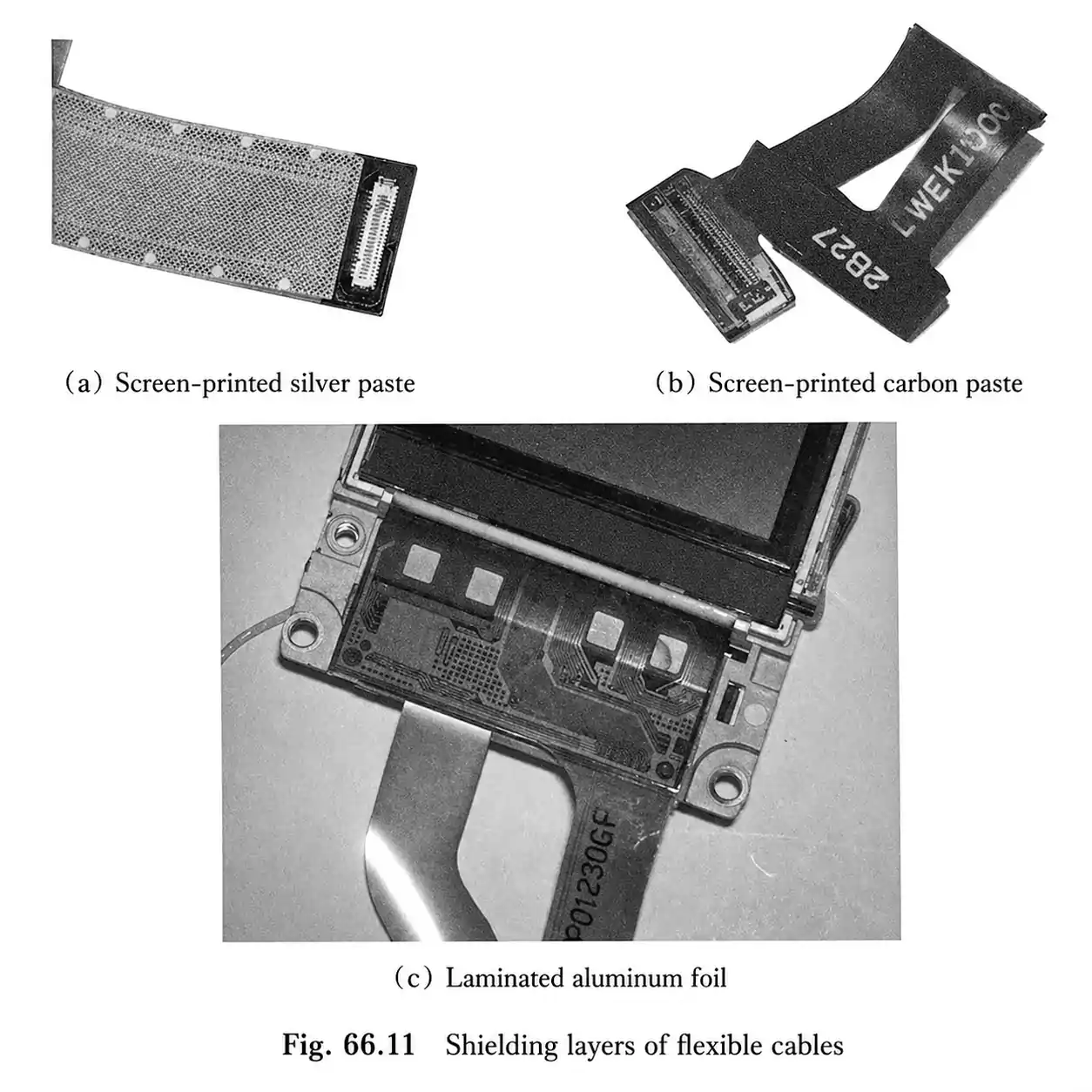
1. Screen-Printed Silver Paste Shielding for Flex PCB
Screen-printed silver-paste shielding is a common EMI shielding method for flexible cables and flex PCB applications.
In this method, conductive silver paste is printed onto the surface of the flexible PCB and then cured to form a conductive shielding layer.
Because silver has good electrical conductivity, silver paste provides strong shielding performance. At the same time, the printed silver layer offers some flexibility, making it suitable for flexible cable designs that need to bend during use.
Advantages of Screen-Printed Silver Paste
- Good shielding performance
- Good bending durability
- Mature process for volume production
- Suitable for selective or localized shielding areas
- Widely used in high-speed flexible cable applications.
Limitations of Screen-Printed Silver Paste
Silver paste is more expensive than some other shielding materials.
For highly cost-sensitive products, designers need to balance shielding performance against manufacturing cost.
2. Screen-Printed Carbon Paste Shielding for Flexible Cables
Screen-printed carbon paste shielding is another option for flexible cable EMI shielding, especially when cost is a major concern.
Like silver paste, it is applied by screen printing and forms a conductive coating on the flex circuit surface.
Compared with silver paste, carbon paste has a much lower material cost. However, its conductivity is also lower, so its shielding effectiveness is more limited.
Advantages of Screen-Printed Carbon Paste
- Low cost
- Simple process
- Suitable for products with modest shielding requirements
- Useful for cost-sensitive applications
Limitations of Screen-Printed Carbon Paste
Carbon paste provides limited shielding performance.
It is usually not the best choice for applications that require strong signal integrity, strict EMC control, or high EMI resistance. For higher-performance shielding, silver paste, metal foil, or other conductive shielding structures are usually preferred.
3. Aluminum Foil Shielding for Flex PCB
Aluminum foil shielding for Flex PCB is a high-reliability solution for flexible cables that require strong EMI protection.
In this process, aluminum foil is laminated to the flex circuit under heat and pressure, forming a continuous metallic shielding layer.
Because aluminum is a metal, it provides strong electromagnetic shielding performance. It also has good flexibility, making it suitable for flexible cables that require both EMI protection and bending reliability.
Advantages of Aluminum Foil Shielding
- Strong shielding performance
- High flexibility
- Suitable for high-reliability applications
- Good choice for high-speed communication products with strict EMI requirements
- Helps improve the long-term stability of flexible cable shielding
Limitations of Aluminum Foil Shielding
Hot-laminated aluminum foil requires careful material matching, lamination control, and structural design.
To avoid delamination, wrinkling, or fatigue damage in bending areas, the shielding region and bend zone should be planned properly during the design stage.
Comparison of Common Flex PCB EMI Shielding Options
| Screen-printed silver paste | Good | Good | Medium to high | High-speed flexible cables, connectors, EMI control applications |
| Screen-printed carbon paste | Limited | Generally good | Low | Cost-sensitive products with basic shielding needs |
| Hot-laminated aluminum foil | Strong | High | Medium to high | High-reliability flexible cables with strong shielding requirements |
How to Choose the Right Flexible Cable Shielding Layer
Choosing a shielding layer for a flexible cable is not just about shielding performance.
The decision should also consider:
- Signal speed
- Bending requirements
- Reliability expectations
- EMC requirements
- Cost targets
- Manufacturing process compatibility
If the product requires both good shielding performance and good flex durability, screen-printed silver paste is often a balanced option. It provides effective EMI shielding while maintaining reasonable flexibility.
If cost is the main concern and the shielding requirement is not very demanding, screen-printed carbon paste may be considered. Its key advantage is low cost, but its shielding capability is limited.
For high-reliability applications that require stronger EMI protection, hot-laminated aluminum foil is usually the more robust solution. It offers strong shielding performance and high flexibility, making it suitable for flexible cable designs with higher performance requirements.
Conclusion
Flex PCB EMI shielding plays a key role in the design of high-speed flexible cables. The right shielding layer helps control interference while preserving bend performance and long-term reliability.
Screen-printed silver paste, screen-printed carbon paste, and hot-laminated aluminum foil each offer different trade-offs in shielding performance, flexibility, reliability, and cost. The best choice depends on signal speed, bending requirements, EMC targets, and product reliability needs.
For projects that require reliable, flexible cable shielding, FastTurnPCB can support flex PCB design review, material selection, and manufacturing for high-speed, high-reliability applications.