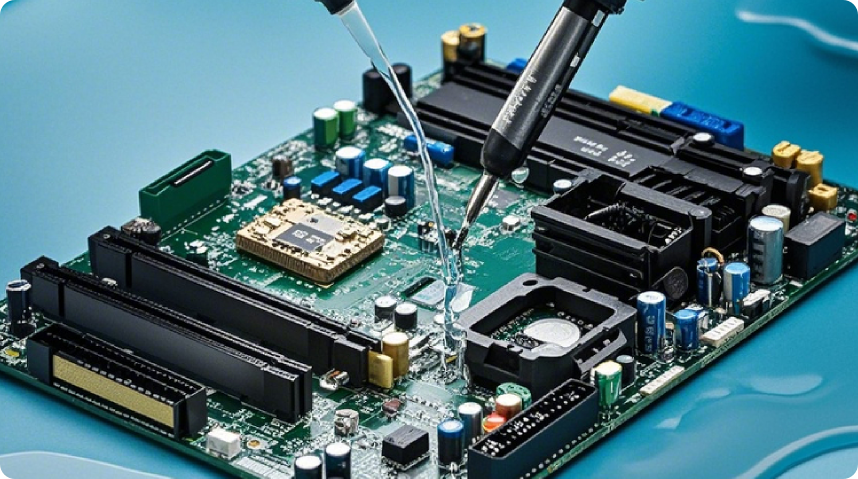
High-Volume PCB Assembly with Precision & Efficiency
We provide expert mass PCB assembly services for high-volume production, ensuring fast turnaround, consistent quality, and cost-effective solutions. From prototype to full-scale runs, upload your Gerbers and BOM now for a competitive quote.
Mass PCB Assembly refers to the process of assembling printed circuit boards (PCBs) in large quantities with high efficiency, consistency, and quality.
It is commonly used in the production stage for consumer electronics, automotive, industrial, and medical applications.
Why is Mass PCB Assembly essential?
Cost Efficiency: Lower cost per unit with volume production
Consistent Quality: Automated processes ensure uniformity and reduce errors
Faster Turnaround: High-speed pick-and-place and reflow lines accelerate delivery
Scalable for Growth: Easily ramp up from prototype to full production
Why Choose Us?
When scaling your product, partnering with the right PCB assembly manufacturer is critical.
End-to-End Turnkey Service
From DFM review and component sourcing to SMT assembly, testing, and packaging - all in one streamlined process.
High-Efficiency Automated Lines
SMT with high-speed pick-and-place, reflow soldering, X-ray inspection, and 3D AOI - ensuring consistent quality at scale.
Scalable Production Capacity
Whether you need thousands or millions of units, we scale flexibly to meet your demands without delays.
Engineering Support That Adds Value
From DFM review and component sourcing to SMT assembly, testing, and packaging - all in one streamlined process.
Certified to Global Quality Standards
ISO 9001, ISO 13485, IPC-A-610, UL, and RoHS compliant – suitable for medical, industrial, and automotive sectors.
Global Component Sourcing
We leverage a worldwide supply chain for strategic sourcing, BOM optimization, and faster lead times.
We follow a fully controlled, high-efficiency production workflow to deliver consistent quality and fast turnaround.
1
Data Validation
2
photo-plotting & lmaging
3
Lamination
4
Drilling
5
Copper Platin
6
Etching
7
Solder Mask Application
8
Silkscreen Printing
9
Surface Finish
10
Electrical & Optical Inspection
11
Routing & Profiling
12
Final Inspection & Packaging
Capabilities
Capability
Parameters
Assembly Types
SMT Assembly( with AOI inspection)
BGA Assembly(with X-Ray inspection)
Through-hole Assembly
SMT & Through-hole Mixed Assembly
Kit Assembly
Quality Inspection
AOI Inspection
X-Ray Inspection
Voltage Test
Chip Programming
ICT Test
Functional Test
PCB Types
Rigid PCB
Metal core PCB
Flex PCB
Rigid-Flex PCB
Component Types
Passives, Smallest Size 0201(inch)
Fine-Pitch Chips to 0.38mm
BGA (0.3mm pitch), FPGA, LGA, DFN, QFN with X-Ray testing
Connectors and terminals
Components Sourcing
Full turnkey
Partial turnkey
Kitted/Consigned
Solder Types
Lead-Free(Rohs)
Files Required for Quote and Production
Gerber RS-274X, 274D, or PCB Design File
BOM (Bill of Materials, xls, xlsx)
Pick-N-Place File / XY File (for production only)
Assembly Drawings
Order quantity
5pcs to 100,000pcs
From Prototypes to Mass Production
Assembly Lead Time
From 8 Hours to 72 hours when parts are ready
Applications
FAQ
Q:What are the main advantages of Mass PCB Assembly?
The main advantages include reducing costs, improving production efficiency, ensuring consistency and reliability of product quality, and responding quickly to market demand.
Q:How to ensure precise placement of components in Mass PCB Assembly?
Advanced automatic surface mount machines are usually used to ensure precise placement of components through high-precision machine vision systems and precise mechanical control.
Q:How to deal with production defects in Mass PCB Assembly?
Production defects are usually detected through online inspection equipment and offline sampling. Once defects are found, they will be immediately marked, isolated, and repaired, and if necessary, the production source will be traced for improvement.
Q:How to improve production efficiency in Mass PCB Assembly?
Methods to improve production efficiency include optimizing production processes, adopting parallel processing technology, increasing equipment utilization, and reducing production interruptions.
Q:How to manage complex supply chains in Mass PCB Assembly?
Managing a complex supply chain requires establishing an effective supplier management system, including supplier evaluation, order management, inventory management, logistics tracking, etc., to ensure timely supply of components and cost control.