

When designing modern electronics, power-path protection is critical. A single short circuit or inrush surge can damage expensive components and shut down entire systems. Traditional glass fuses or PTC resettable fuses offer basic protection, but they respond slowly and lack precision.
That’s where the eFuse (electronic fuse) comes in — a compact, intelligent IC that monitors voltage and current electronically, reacting in microseconds to protect your circuit.
This guide explains what is eFuse, how it works, why it’s replacing conventional fuses, and how to choose and apply one effectively in your PCB design.
What is an eFuse?
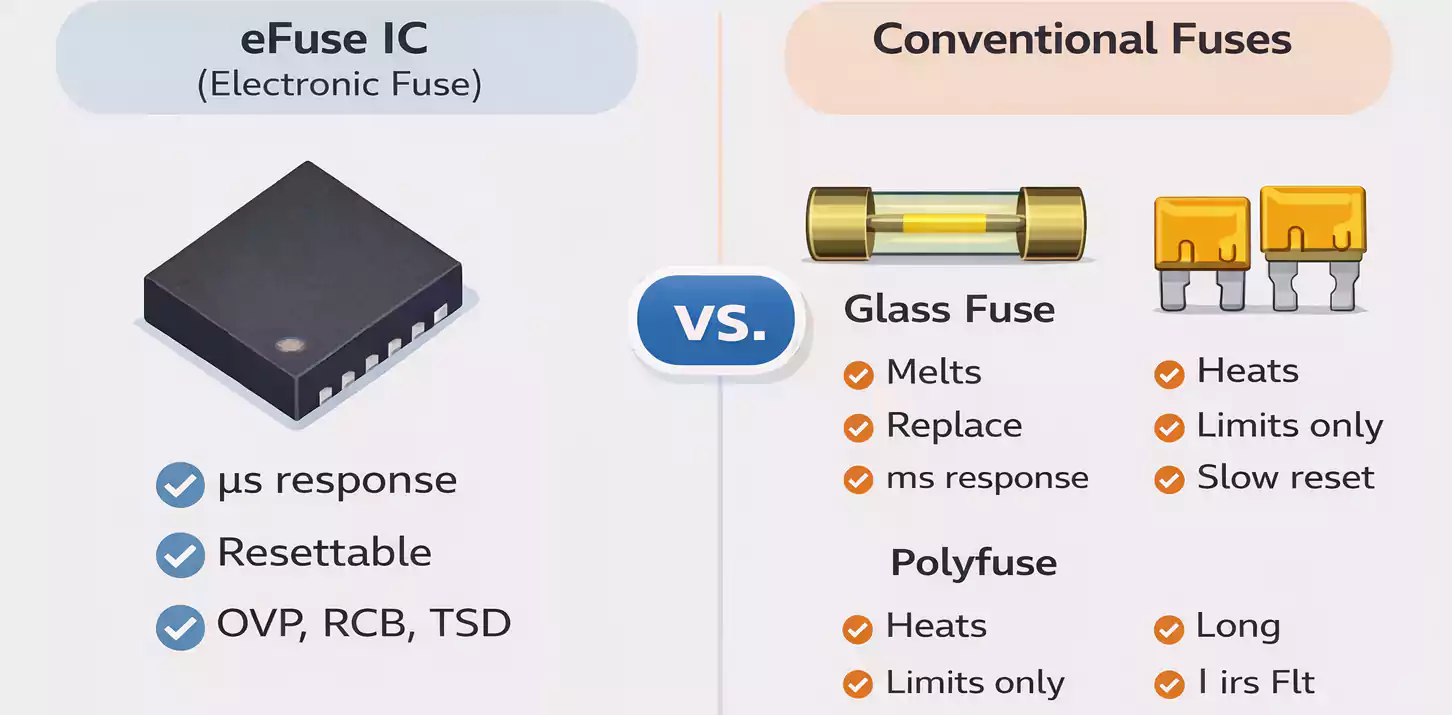
An eFuse, or electronic fuse, is a solid-state protection device that acts as an intelligent power switch. Instead of relying on thermal melting like a glass fuse or the temperature-dependent resistance of a PTC, the eFuse detects over-current, short-circuit, or over-voltage conditions electronically and controls an internal MOSFET to disconnect or limit current flow.
Once the fault is cleared, the eFuse can automatically or manually restore the connection. It is, in essence, a self-resetting, precision fuse IC.
In short, an eFuse = MOSFET + current sense + control logic + protection features — all integrated into one chip.
The term “eFuse” also refers to on-chip one-time programmable (OTP) fuses used in SoCs for device ID, security keys, or configuration storage. In this article, we focus on board-level electronic fuses used for power-path protection.
Why Use an eFuse? The Problems It Solves
Modern electronics draw large transient currents during power-up or load-switching events. eFuses protect against:
- Over-current or short-circuit faults: Detects excessive load and limits or shuts off current instantly.
- Inrush current: Controls charging of large output capacitors at startup.
- Over-voltage transients: Clamps or disconnects when input voltage exceeds safe levels.
- Reverse current or reverse polarity: Prevents back-flow that could damage upstream circuitry.
- Thermal overload: Shuts down the MOSFET when the internal temperature rises too high.
This combination of speed, precision, and recoverability makes eFuses ideal for USB-powered devices, battery systems, servers, and automotive electronics.
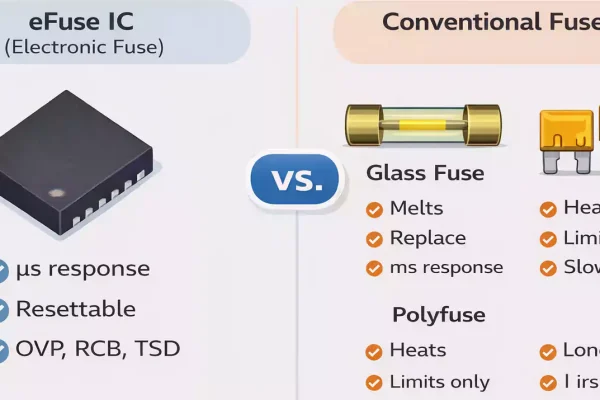
eFuse vs. Glass Fuse vs. Polyfuse (PTC)
One of the most common questions engineers ask is: “How is an eFuse different from a fuse or a PTC?”
Let’s break it down.
1. How They Work
| Glass Fuse | Metal wire melts from excessive heat | Slow (milliseconds) | Must be replaced |
| Polyfuse / PTC | Polymer material heats up and increases resistance | Moderate | Auto reset after cooling |
| eFuse IC | Measures current/voltage, drives a MOSFET to limit or cut off | Very fast (µs range) | Auto or controlled reset |
Traditional fuses depend on heat buildup. eFuses rely on active electronic sensing — making them far more precise and consistent.
2. Response and Recovery
- Glass fuse: Once blown, it’s gone.
- PTC fuse: Can reset after cooling, but recovery time is slow, and behavior is nonlinear.
- eFuse: Can auto-retry after a fault, or latch off until an enable signal resets it — giving designers complete control.
3. Auto-Retry vs. Latch Mode
Most eFuses support two operating modes:
- Auto-retry mode: The device automatically re-enables power after a short period of inactivity. Useful for consumer or portable systems that must recover without user intervention.
- Latch-off mode: The eFuse remains off until a controller or MCU toggles the enable pin — preferred in safety-critical or industrial systems.
How an eFuse Works
An eFuse integrates several blocks that work together to monitor and protect the power path.
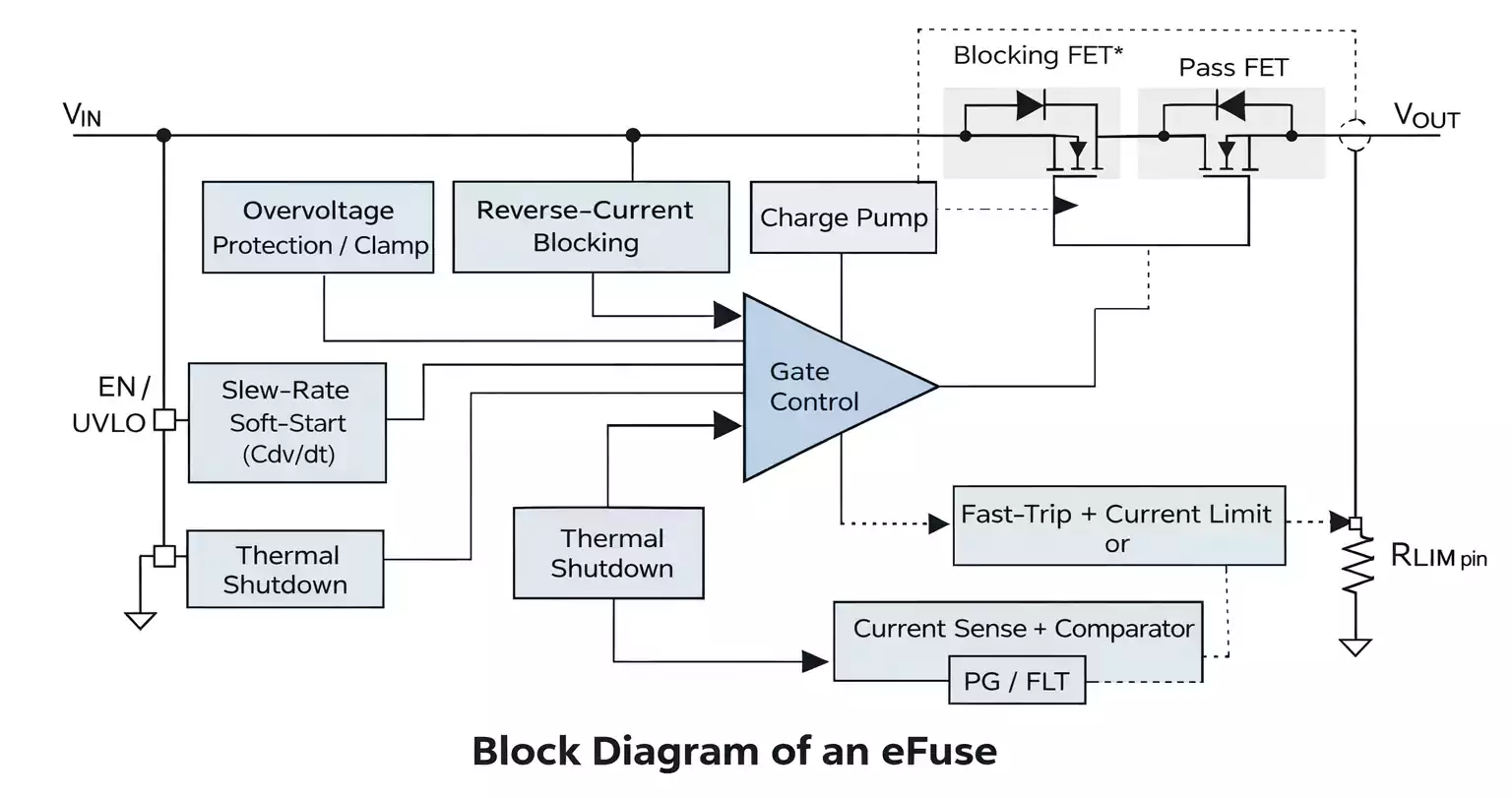
Internal Structure
- MOSFET Switch: Carries the load current and disconnects power during a fault.
- Current Sense Circuit: Measures voltage drop across a shunt resistor or internal sense FET.
- Comparator/Control Logic: Detects whether the current or voltage exceeds the programmed limits.
- Gate Driver: Quickly turns the MOSFET on or off to limit current or shut down.
- Protection Features: OCP (overcurrent), OVP (overvoltage), reverse blocking, and thermal shutdown.
When the sensed current exceeds the threshold, the device enters current-limit mode — clamping the current at a fixed level — or switch-off mode, disconnecting the load entirely. The choice depends on device configuration.
Programmable Current Limit
Most eFuses let designers set the current limit (ILIM) by connecting an external resistor to a reference pin. Adjusting ILIM allows the device to protect sensitive loads or handle large startup surges precisely.
Example:
ILIM=K/RILIM
where K is a constant provided in the datasheet.
Built-In Protection Functions
One reason eFuses are so popular is that they combine multiple protection mechanisms into a single small chip. The most common include:
- OCP (Over-Current Protection): Limits or cuts off the load current when it exceeds a set threshold.
- SCP (Short-Circuit Protection): Detects severe faults and instantly shuts off to prevent board damage.
- OVP (Over-Voltage Protection): Clamps or disconnects the output if the input voltage spikes.
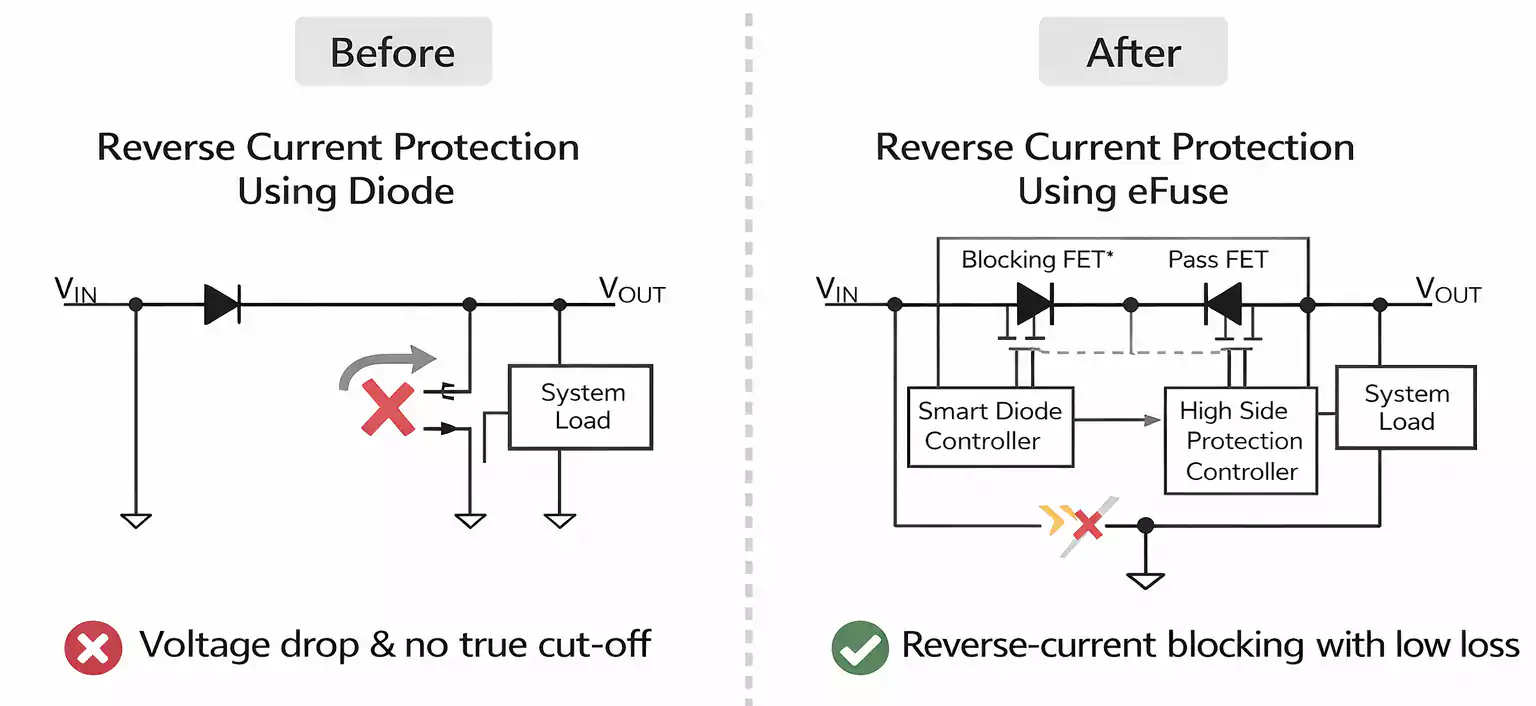
- RCB (Reverse-Current Blocking): Prevents current from flowing backward when power sources are paralleled or hot-swapped.
- TSD (Thermal Shutdown): Turns off the FET if the die temperature exceeds the safe limit.
- Inrush / Slew-Rate Control: Soft-starts the load to avoid voltage dips or connector arcing during plug-in.
- Reverse Polarity Protection: In some devices, the MOSFET orientation blocks reverse input connection.
Essentially, an eFuse does the job of several discrete components — a fuse, TVS diode, MOSFET switch, and protection controller — in a single IC.
Advantages Over Conventional Fuses
- Speed and precision: Detects overcurrent electronically within microseconds instead of relying on thermal delay.
- Resettable and maintenance-free: No need to replace a blown fuse — recover automatically or by software command.
- Integration and space-saving: Combines multiple protection functions into a single chip, reducing PCB area and BOM cost.
- Consistent behavior: Protection thresholds remain stable over temperature and aging, unlike polymer fuses.
- System intelligence: Status pins or I²C telemetry enable real-time fault monitoring and diagnostics.
For high-reliability or densely packed boards, those advantages are hard to ignore.
Key Integrated Protection Features
Modern eFuse ICs pack multiple safeguards into a single package:
- Over-Current Protection (OCP): Limits current to a precise threshold.
- Short-Circuit Protection (SCP): Detects near-zero output voltage and shuts down instantly.
- Over-Voltage Protection (OVP): Clamps or disconnects when VIN exceeds safe limits.
- Reverse-Current Blocking (RCB): Prevents current from flowing backward when VIN drops below VOUT.
- Thermal Shutdown (TSD): Monitors the die temperature and turns off at ~150 °C.
- Slew-Rate / Inrush Control: Smooths power-up to prevent large capacitor charging spikes.
- Reverse Polarity Protection: Certain eFuses integrate body-diode control or external diode logic.
By combining these functions, a single eFuse can replace multiple discrete components such as MOSFETs, comparators, and resistors.
Why eFuse ICs Are Better for PCB Design
eFuses offer several real-world benefits compared with traditional protection methods:
- Precision and Speed:
They monitor current and voltage directly — no thermal delay.
This means faster reaction times and less risk of component overstress. - No Replacement or Downtime:
Faults clear automatically, which minimizes service calls and downtime. - Compact and Integrated:
A single IC can replace fuse holders, MOSFETs, and sensing circuits, saving PCB area. - Design Flexibility:
Designers can fine-tune protection thresholds, enabling more intelligent power management. - Diagnostic Capability:
Many devices feature fault pins or I²C interfaces to report protection status to the system MCU.
How to Choose the Right eFuse
When selecting an eFuse for your design, consider these parameters:
1. Input Voltage Range
Check that the VIN covers your nominal and transient conditions. For example, 4.5–18 V for USB or 9–36 V for automotive lines.
2. Continuous and Peak Current
Select an IC rated above your system’s steady-state current but below the maximum safe level for traces and connectors.
3. Current-Limit Setting (ILIM)
Use the formula or the lookup table in the datasheet to select the appropriate resistor value for your limit.
4. Fault-Recovery Behavior
Decide between auto-retry (for unmanned systems) or latch (for manual restart).
5. Built-In Features
Determine whether you need additional functions such as:
- Over-voltage clamp
- Reverse current blocking
- Thermal shutdown
- Adjustable slew-rate control
6. Power Loss and Thermal Design
Check RDS(on) — the lower, the better for efficiency.
Ensure adequate copper area or vias for heat spreading.
7. Diagnostic Output
If system feedback is essential, pick an eFuse with a FAULT or PG (Power Good) signal.
Typical Applications
1. USB and Type-C Ports
USB power delivery requires fast and repeatable protection.
eFuses protect VBUS from short circuits, overvoltage, or back-drive conditions during hot-plug events — something no glass fuse can do reliably.
2. Consumer and Computing Devices
Laptops, SSDs, printers, game consoles, VR headsets, and smart speakers all use eFuses to guard internal DC rails.
They allow automatic recovery after transient faults, reducing service costs and downtime.
3. Industrial Power Distribution
In 12 V or 24 V industrial systems, eFuses provide resettable branch protection with diagnostic feedback — replacing bulky relays or manual breakers.
4. Automotive and EV Power Systems
High-voltage eFuses are emerging for EV battery and inverter protection.
Unlike thermal fuses that react in milliseconds, semiconductor fuses can disconnect a faulted path in microseconds — fast enough to protect SiC or GaN power devices.
5. Servers and Storage Equipment
In data centers, eFuses prevent backfeed between redundant power supplies and enable precise fault isolation for hot-swappable blades and drives.
Standard Design and Troubleshooting Tips
PTC Limitations Reminder:
PTCs don’t entirely cut power; they only restrict current. This can leave circuits partially energized during faults — unsafe for high-power systems.
False Trips on Startup:
Large output capacitors can cause high inrush current. Increase ILIM or add a soft-start capacitor to slow the slew rate.
“Hiccup” Auto-Retry Behavior:
If the fault persists, the eFuse cycles repeatedly. Disable auto-retry or fix the root cause.
Thermal Overload:
High RDS(on) or insufficient copper can cause heat buildup. Use wider traces or multiple vias.
Can an eFuse Replace a Physical Fuse?
Functionally, yes — but regulatory standards (e.g., UL, IEC) may still require a physical fuse for safety compliance. eFuses are often used in addition for secondary protection.
FAQ
Why does the eFuse trip at startup?
Because the load capacitor causes a large inrush current, increase the soft-start capacitor or current-limit threshold.
Why does it repeatedly restart (“hiccup” behavior)?
In auto-retry mode, if the fault remains, the device cycles between on and off. Switch to latch-off mode if continuous retries are undesirable.
Can an eFuse completely replace a traditional fuse?
In most low-voltage electronic systems, yes.
However, for specific safety certifications (e.g., UL/IEC for mains protection), a physical fuse may still be required in series.
Why not just use a Polyfuse?
PTCs limit current but still allow significant voltage and heat buildup during faults. eFuses provide true disconnection and repeatable response time.
The Other Kind of eFuse (On-Chip OTP Fuses)
The term “eFuse” can also refer to tiny fuses fabricated within ICs.
These on-chip eFuses are one-time programmable links that permanently open when a small current pulse melts them.
They store calibration data, turn hardware features on or off, and lock cryptographic keys for secure boot or device ID.
Although both share the “fuse” concept, they serve different purposes:
| Location | On PCB, in power path | Inside SoC or MCU silicon |
| Purpose | Protect circuits from faults | Store configuration / security bits |
| Reusable | Yes (resettable) | No (one-time programmable) |
Conclusion: When to Choose an eFuse
Choose an eFuse when your design requires:
- Fast, precise protection for sensitive loads
- Automatic recovery without manual fuse replacement
- Compact integration of overcurrent, overvoltage, and reverse blocking
- Diagnostic feedback and intelligent system control
For low-cost, disposable products, a simple fuse may still be OK.
But for high-reliability, compact, or service-free designs, eFuses deliver a modern, intelligent layer of power protection that mechanical fuses can’t match.