



PCB thickness is a critical parameter in PCB design because it affects mechanical strength, assembly compatibility, manufacturability, and long-term reliability. While many designers focus first on layer count, copper weight, trace width, and hole size, overall board thickness also plays an important role in product performance.
For most standard electronic products, the common PCB thickness is 1.6 mm. However, standard thickness is not suitable for every application. When a design requires greater rigidity, supports heavier components, or must withstand higher mechanical stress, a thick PCB board may be a better choice.
This article explains what a thick PCB board is, how it differs from standard PCB thickness, and how to choose the right thickness for your application.
What Is a Thick PCB Board?
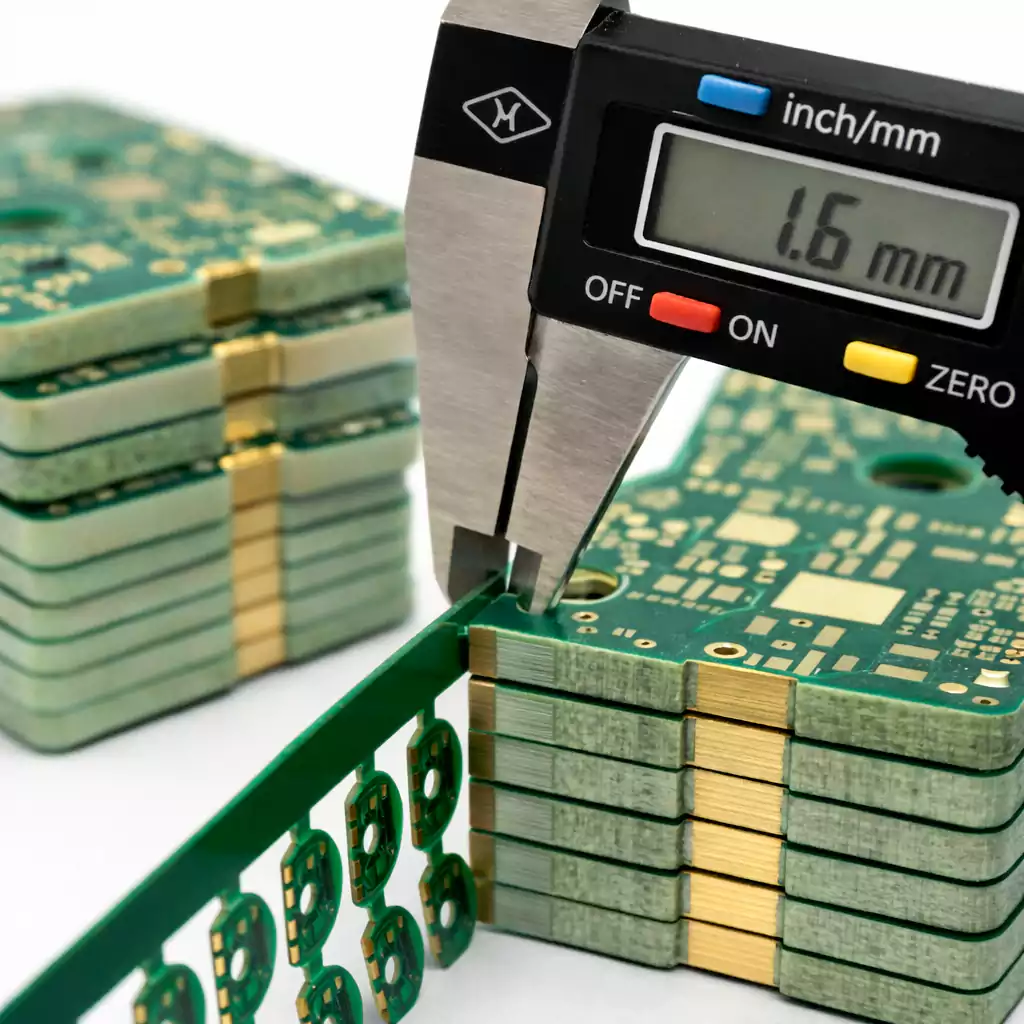
A thick PCB is a printed circuit board with an overall finished thickness greater than that typically used in standard electronic products. In most cases, 1.6 mm is the standard reference point for a rigid PCB. Once the board thickness reaches 2.0 mm, 2.4 mm, 3.2 mm, or higher, it is more often referred to as a thick PCB, especially in industrial or mechanically demanding applications.
The key point is that a thick PCB board refers to the total board thickness, not just the thickness of a single layer or material within the stackup. That total thickness may be built through thicker cores, more prepreg, more layers, or a combination of structural requirements.
Thicker board is typically chosen to improve rigidity, reduce bending, support heavier components, or meet installation requirements, and is generally driven by mechanical and structural needs rather than convention.
What Is the Standard PCB Board Thickness?
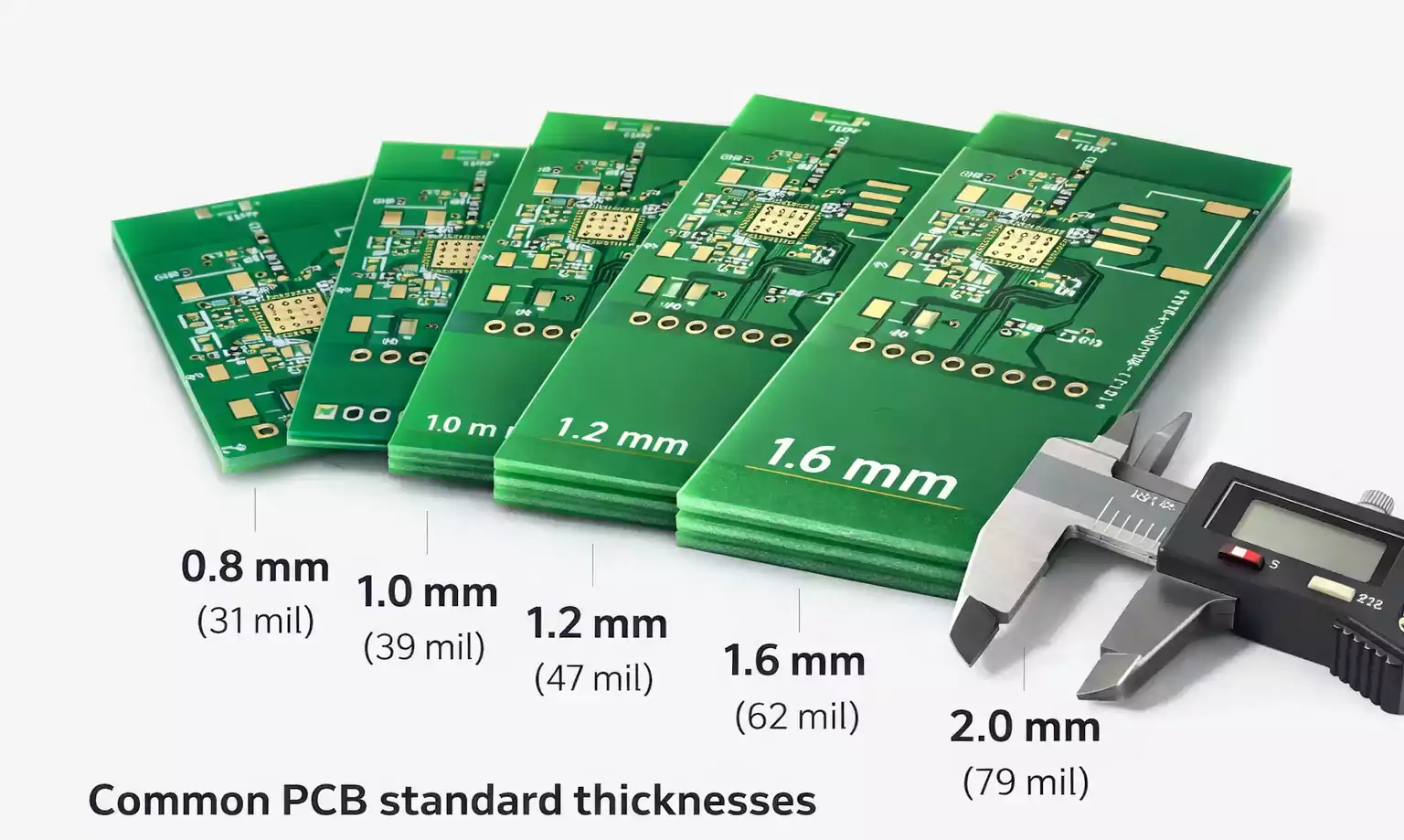
The standard PCB board thickness most commonly referenced is 1.6 mm, or approximately 0.062 inches (62 mil). This thickness is widely used because it offers a practical balance of mechanical strength, manufacturability, connector compatibility, and cost.
However, PCB thickness is not limited to a single value. Common finished thicknesses include 0.4 mm, 0.6 mm, 0.8 mm, 1.0 mm, 1.2 mm, 1.6 mm, and 2.0 mm. Thinner boards are often used in compact or lightweight devices, while thicker boards are preferred when greater rigidity or specific structural support is required.
Overall, 1.6 mm remains the most common choice for rigid PCB applications because it is compatible with a wide range of components, connectors, manufacturing processes, and enclosure designs. When product requirements change, another thickness may be more suitable.
Thick PCB Board vs. Heavy Copper PCB
A thick PCB board and a heavy copper PCB are related, but they are not the same. The table below highlights the main differences:
| Item | Thick PCB Board | Heavy Copper PCB |
|---|---|---|
| Definition | Refers to the overall finished thickness of the PCB | Refers to the thickness or weight of the copper layers |
| Main Focus | Board structure and mechanical performance | Electrical current capacity and thermal performance |
| Key Impact | Affects rigidity, bending resistance, drilling difficulty, and structural strength | Affects current carrying capability, heat distribution, and trace design |
| Typical Design Purpose | Used when greater mechanical support or a thicker structure is required | Used when higher current or better thermal handling is needed |
| Can It Exist Alone? | Yes, a board can be thick without heavy copper | Yes, a board can use heavy copper without being unusually thick overall |
| In Power Electronics | May be used for structural strength | Often used for high current and thermal demands |
| Engineering Concern | Board flexing, enclosure fit, and mechanical stability | Copper weight, thermal spreading, and current handling |
Why Use a Thick PCB Board?
A thick PCB board is not automatically better than a standard board, but it can offer clear advantages in the right application.
1. Better Mechanical Strength
A thicker board is more rigid and less likely to bend under load. This is especially important for large-format PCBs, boards mounted in high-vibration environments, or products that may experience handling stress during assembly, transport, or operation.
2. Better Support for Heavy Components
Some PCBs need to support bulky or heavy components such as transformers, inductors, heat sinks, power modules, relays, or large connectors. In these cases, a thicker board provides a more stable platform and reduces the risk of flexing around mounting points and solder joints.
3. More Suitable for Harsh Environments
Industrial electronics, automotive systems, aerospace equipment, railway controls, and outdoor power systems often face vibration, shock, or higher long-term mechanical stress. A thick PCB board is often preferred in these environments because it can provide better structural reliability.
4. Better Fit for Large Boards or Special Stackups
As board size increases, the chance of bending or warping also increases. A thicker board can help maintain flatness and dimensional stability. In multilayer designs, the stackup itself may already push the finished board toward a thicker structure, especially when insulation spacing, layer count, or structural demands are higher than normal.
Key Factors That Affect PCB Board Thickness
Choosing PCB thickness is never a one-variable decision. Several design and manufacturing factors influence the final thickness.
1. Number of Layers
As the number of layers increases, the total thickness often increases as well. More copper layers require more dielectric material between them, and the final stackup must still meet electrical, thermal, and mechanical requirements.
2. Copper Thickness
Copper weight contributes to the total finished thickness, although usually not as dramatically as core and prepreg thickness. Still, in power designs or heavy copper applications, copper thickness becomes an important part of the total stackup and may affect spacing rules and production capability.
3. Material and Stackup Design
Board thickness depends heavily on core thickness, prepreg selection, resin content, and the overall lamination plan. Two boards with the same layer count may have different finished thicknesses if their stackups differ.
4. Mechanical Requirements
If the product requires more rigidity, stronger support, or resistance to mechanical deformation, thickness becomes a key design lever. This is often the real reason behind choosing a thick PCB board.
5. Product Structure and Assembly Constraints
Sometimes the enclosure, mounting hardware, edge connector, slot, or mechanical fixture determines the acceptable board thickness. In these cases, thickness is not just a preference. It is a structural requirement.
Design and Manufacturing Challenges of Thick PCB Boards
Although thick PCBs offer mechanical advantages, they also create additional design and fabrication challenges.
1. Drilling Becomes More Difficult
As the board gets thicker, drilling plated through holes becomes more difficult. Hole aspect ratio becomes more critical, and it is harder to maintain hole quality and plating consistency in deeper holes. This can limit the minimum drill size and may require more careful DFM planning.
2. Via Reliability Requires More Attention
In thicker boards, plating inside vias and through holes must be controlled carefully. If the plating is not uniform enough, reliability risks may increase over time, especially in applications exposed to thermal cycling or vibration.
3. Warpage and Bow/Twist Must Be Controlled
A thicker board is stiffer, but that does not automatically eliminate warpage. Large boards, uneven copper distribution, and unbalanced stackups can still cause bow or twist. Good layer symmetry and balanced copper distribution remain important.
4. Surface Finish and Process Compatibility Matter
Some non-standard thickness configurations may interact with process capability, especially when very thin materials, very thick boards, or special surface finish requirements are involved. That is why it is important to confirm manufacturing capability early rather than assuming all thickness options are equally available.
5. Cost and Lead Time Usually Increase
A thick PCB board often costs more than a standard 1.6 mm PCB. More material, tighter process control, stricter drilling constraints, and lower standardization can all increase fabrication costs and, in some cases, extend lead times. For that reason, a thick board should be selected because it is necessary, not just because it seems stronger.
How to Choose the Right Thickness for Your PCB
The best way to choose PCB thickness is to start with the actual application requirements rather than defaulting to the thickest possible option.
Step 1: Start With the Product Structure
Check the enclosure, slot width, mounting method, connector type, and overall installation requirements. In many products, these factors set thickness limits before layout even begins.
Step 2: Evaluate Board Size and Component Weight
If the board is large or supports heavy components, rigidity becomes more important. A standard 1.6 mm board may be sufficient for many compact designs, but larger or heavier assemblies may benefit from a 2.0 mm or greater board.
Step 3: Confirm Layer Count and Copper Requirements
The electrical design and stackup plan affect the final board thickness. If the project includes many layers, thicker dielectric requirements, or heavy copper, the finished thickness may naturally increase.
Step 4: Review Fabrication Limits Early
Before finalizing the design, confirm the manufacturer's drilling capability, hole aspect-ratio limits, thickness tolerance, and stack-up feasibility. Early DFM review helps prevent redesign later.
Step 5: Choose the Thinnest Thickness That Still Meets Reliability Needs
This is often the best engineering rule. Do not choose a thick PCB board just because it sounds stronger. Choose the minimum thickness that still provides the required rigidity, manufacturability, and long-term reliability. This usually leads to better cost control and easier production.
Typical Applications of Thick PCB Boards
Thick PCB boards are commonly used in applications where mechanical performance is just as important as electrical performance. Typical applications include:

- Industrial control equipment
Large boards in industrial systems often need greater rigidity and better resistance to vibration. - Automotive electronics
Thicker boards are often used in automotive systems that require stronger structural support and improved durability. - Aerospace and railway electronics
These applications demand long-term reliability under vibration, stress, and harsh operating conditions. - Power electronics
Thick PCB boards are well suited for assemblies with heavy components and more demanding mechanical requirements. - Large communication or backplane boards
Greater board thickness helps improve rigidity and maintain dimensional stability in larger designs.
In these applications, a thicker board can provide a better balance between structural strength and long-term product reliability.
Frequently Asked Questions
What is the standard PCB board thickness?
The most common standard PCB board thickness is 1.6 mm, or about 0.062 inches.
What thickness is considered a thick PCB board?
There is no single universal cutoff, but 2.0 mm and above is commonly treated as thick PCB territory, especially in rigid industrial applications.
Is a thick PCB board the same as a heavy copper PCB?
No. Thick PCB refers to total board thickness, while heavy copper refers to copper layer thickness.
Does a thicker PCB always mean better performance?
Not always. A thicker board usually improves rigidity, but it may also increase cost and manufacturing complexity. The best choice depends on the application.
Are thick PCB boards more expensive?
In most cases, yes. Thicker boards often require more material and tighter process control, which can raise both cost and lead time.
Conclusion
PCB thickness is not just a dimensional detail. It directly affects board rigidity, manufacturability, component support, and product reliability. For many applications, 1.6 mm remains the standard PCB board thickness because it offers a reliable balance of cost, strength, and compatibility. But when a design must handle larger board sizes, heavier components, harsher environments, or stricter structural requirements, a thick PCB can be the better choice.
The key is not to assume that thicker is always better. The right solution is the thickness that best matches the product's real electrical, mechanical, and manufacturing needs. For teams developing rigid PCBs for demanding applications, working with an experienced manufacturer such as FastTurnPCB can help make thickness selection, stackup planning, and production decisions much more efficient.