

PCB design has traditionally treated the board as a platform for mounting components and routing electrical connections. Resistors, capacitors, ICs, and other parts are typically placed on the surface and connected through copper traces, vias, and solder joints.
As electronics push toward higher density, smaller form factors, faster data rates, and higher frequencies, that traditional approach is reaching its limits. This is where PCB-embedded components become increasingly important.
By integrating components inside the board rather than only on its surface, designers can improve space utilization, increase integration, and support more advanced PCB architectures. This article explains what embedded PCB components are, how they are implemented, and why they matter in modern PCB design.
What Are PCB Embedded Components?
PCB embedded components are components formed within the PCB structure or embedded between its layers.
Unlike traditional surface-mounted parts, these components are built into the board itself and become part of the multilayer stackup. They can include both passive components, such as resistors, capacitors, and inductors, as well as active components used for signal processing or control.
In practical terms, embedded components change the role of the PCB from a basic interconnect platform to a more integrated functional structure.
Why Are Embedded Components Used in PCB Design?
The traditional role of a PCB is to provide physical support and electrical connections for components. But as electronic systems continue to evolve, embedded components in PCB design have become an increasingly valuable option. Several major trends are driving this shift.
1. Electronic products keep getting smaller while doing more
Electronic devices continue to shrink, but their functionality keeps expanding. Surface area is limited, and as component density increases, layout and routing become much more difficult. Moving components onto the PCB is one effective way to increase integration density.
2. Signal speeds continue to increase
As signal speeds rise, long interconnect paths and parasitic effects become more problematic. Embedding components closer to the related circuitry can shorten electrical paths and improve performance.
3. High-frequency applications are becoming more common
High-frequency circuits are more sensitive to PCB structure and layout. Compared with conventional surface-mount designs, embedded components in PCB design provide greater flexibility and can help optimize local electrical performance.
4. Reliability requirements are getting stricter
In products where reliability is critical, embedded components can reduce the number of exposed components and surface solder joints, helping create a more compact and mechanically stable system.
Basic Concepts Behind Embedded PCB Components
To understand embedded PCB components clearly, it helps to first define a few basic terms.
1. Component
A component is a basic building block of an electrical or electronic system and is essential to circuit functionality.
2. Passive component
Passive components include resistors, capacitors, and inductors. They affect current, voltage, impedance, or frequency response in a circuit, but they do not provide current or voltage gain.
3. Active component
Active components can provide gain or perform functions such as amplification, driving, control, or signal processing.
4. Embedded component
An embedded component is one that is either formed within an interconnection substrate or embedded within it. It may be passive or active.
The Two Main Types of Embedded Components in PCB Design
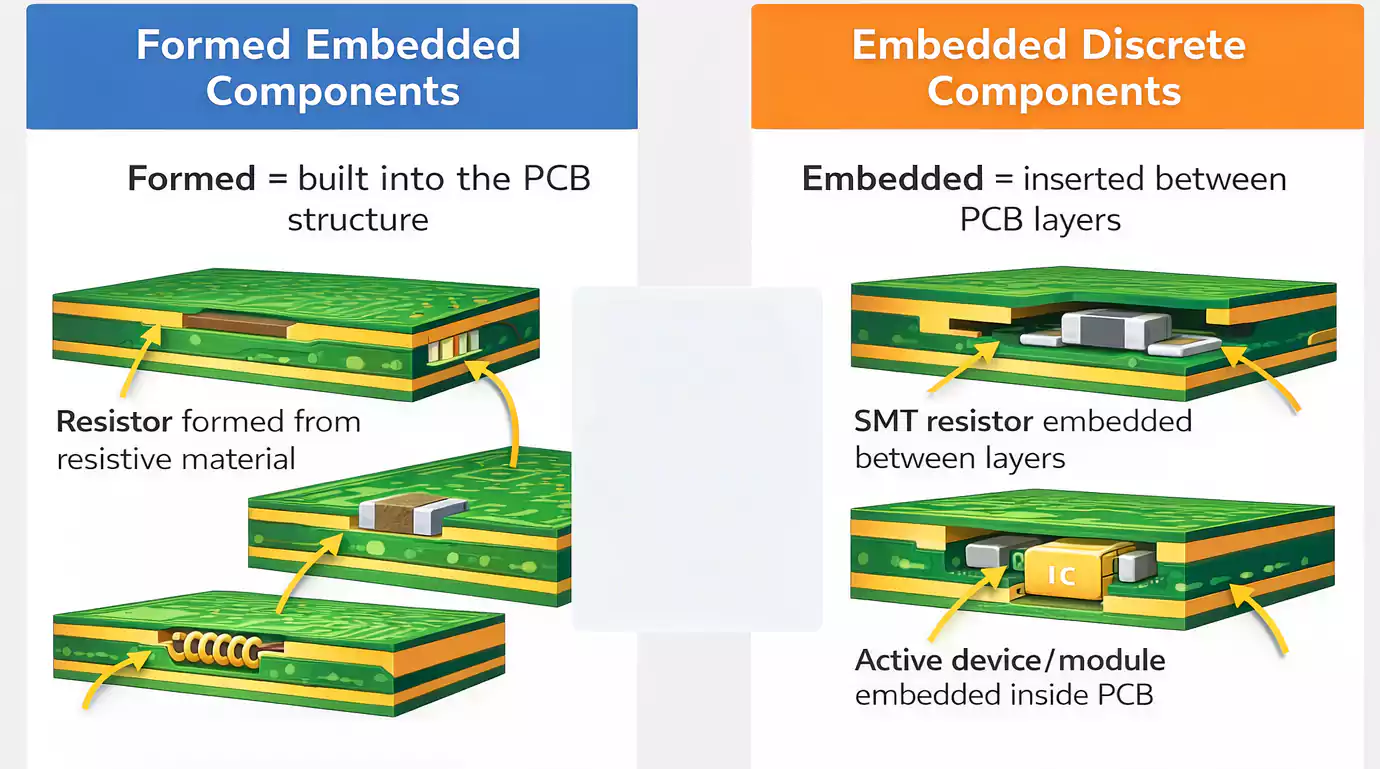
From an implementation standpoint, embedded components in PCB design generally fall into two categories: formed and embedded.
1. Formed embedded components
These components are created directly on the PCB during manufacturing. In other words, they are not made as separate parts and then inserted into the board. Instead, PCB materials and fabrication processes are used to create resistor, capacitor, or inductor functionality on the board.
Examples include:
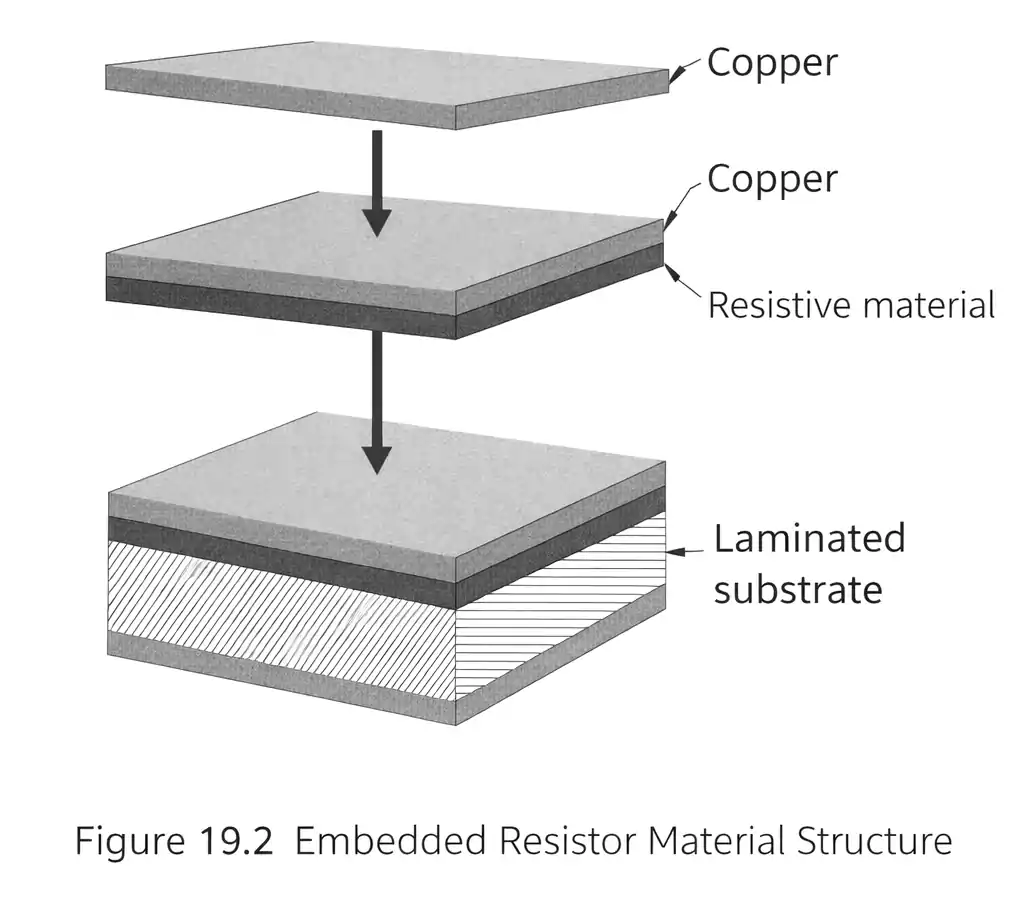
- Using resistive material to create embedded resistors
- Using copper layers and dielectric material to create embedded capacitors
- Using inner-layer coil patterns to create embedded inductors
This approach is closely related to embedded passive technology, especially when passive functions are built directly into the board structure.
2. Inserted embedded components
These are discrete components, but instead of being mounted on the PCB surface, they are placed between PCB layers and then encapsulated within the board through lamination and interconnection processes.
Examples include:
- Embedding SMT resistors in inner layers
- Embedding SMT capacitors in inner layers
- Embedding certain active devices or modules inside the board
A simple way to think about it is this:
- Formed means the function is built directly into the board.
- Embedded means the component itself is placed inside the board
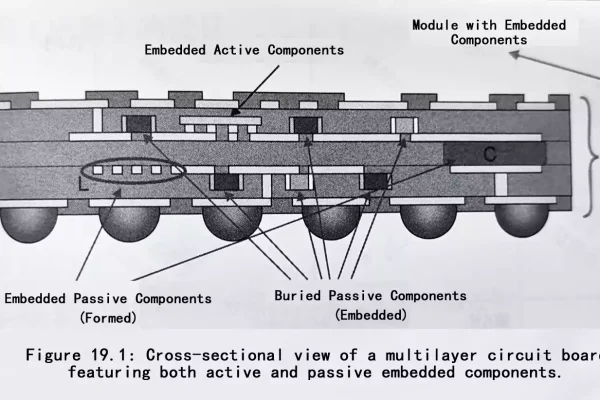
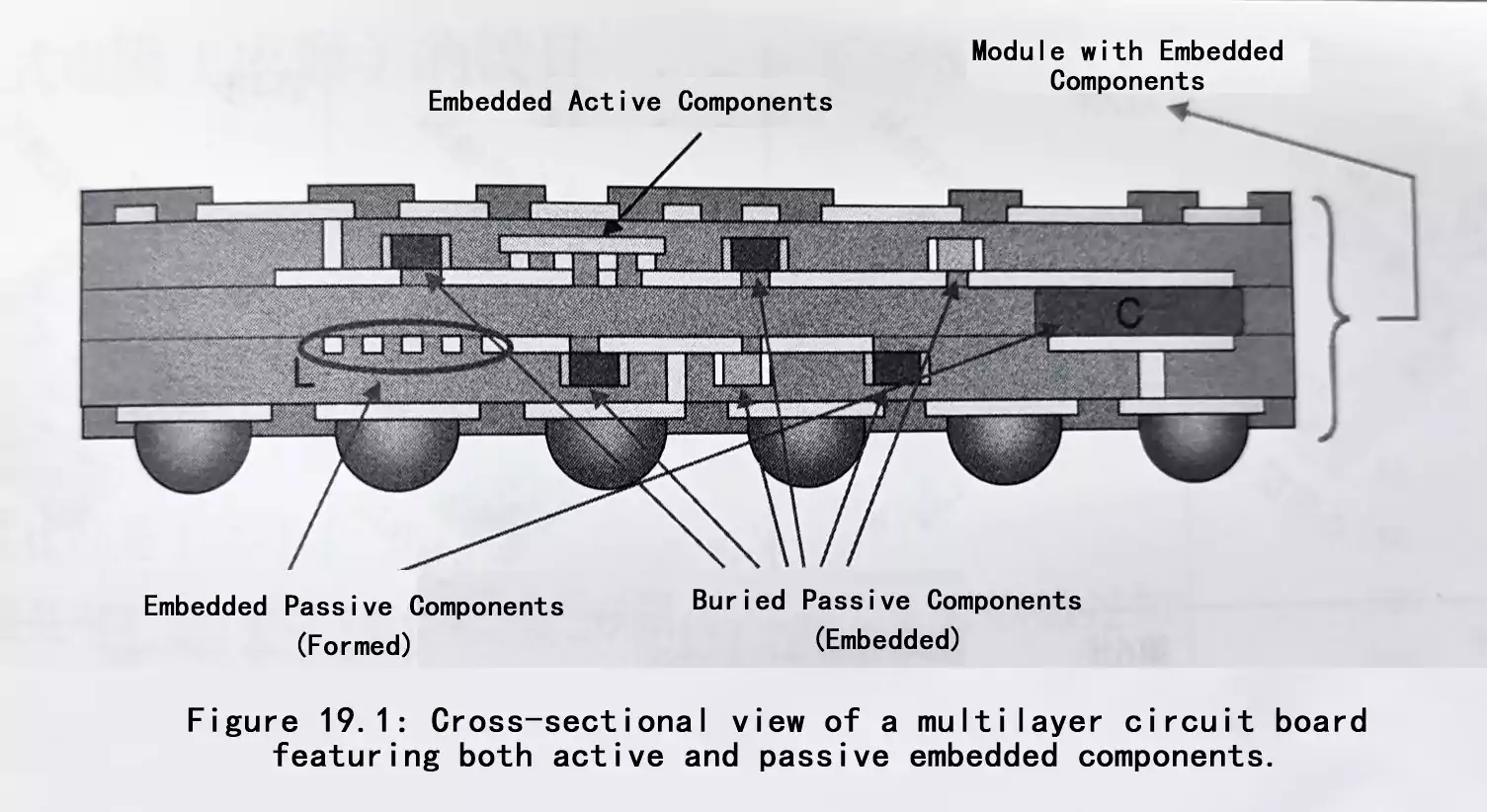
In a typical multilayer PCB cross-section, a design may include embedded active components, embedded passive components, and even modules containing embedded functions. This shows that PCB-embedded components are not simply parts hidden inside a PCB. They are part of a broader design approach that closely ties together structure, materials, and manufacturing.
How are PCB-embedded components implemented?
PCB embedded components are not based on a single method. There are several ways to implement them in modern PCB manufacturing.
1. Embedding SMT components in inner layers
One common approach is to place SMT resistors, capacitors, and similar components directly in the inner layers of the PCB. This shows that embedded technology is not limited to board-formed structures; it can also be applied to standard discrete components.
2. Creating resistor functionality with special materials
Instead of embedding a finished resistor, it is also possible to create resistive structures directly inside the PCB. For example, a resistor pattern can be etched into a resistive material layer and then connected to the rest of the circuit through standard multilayer board processing.
This means resistance does not always have to come from a separate chip resistor. It can be integrated directly into the board as embedded resistors.
3. Creating capacitor functionality with thin dielectric layers
Capacitance can also form within the PCB. The basic idea is simple: when two conductive layers are separated by a thin dielectric material, they form a capacitor.
By controlling copper area, dielectric thickness, and layer spacing, embedded capacitors can be built directly into the board structure.
4. Creating inductance with inner-layer copper coil patterns
If a specific copper coil pattern is designed in an inner layer, it can provide inductive behavior. This allows some inductive functions to be integrated into the PCB as embedded inductors, rather than relying entirely on discrete external inductors.
Why Embedded Components Matter: Beyond the PCB as a Carrier
Traditionally, a PCB has mainly been seen as a mechanical support and electrical interconnection platform. PCB embedded components change that perspective by turning the PCB into a more integrated functional platform.
In this type of design, the PCB does more than connect components. It can also:
- Provide built-in resistance
- Provide built-in capacitance
- Provide built-in inductance
- House active or passive devices internally
- Work with the multilayer structure as part of a functional module.
That is one of the most important ideas behind embedded components in PCB technology.
Advantages of Embedded PCB Components Compared with Traditional Surface-Mount Designs
Embedded PCB components attract attention because they can deliver higher integration and better electrical performance in certain applications.
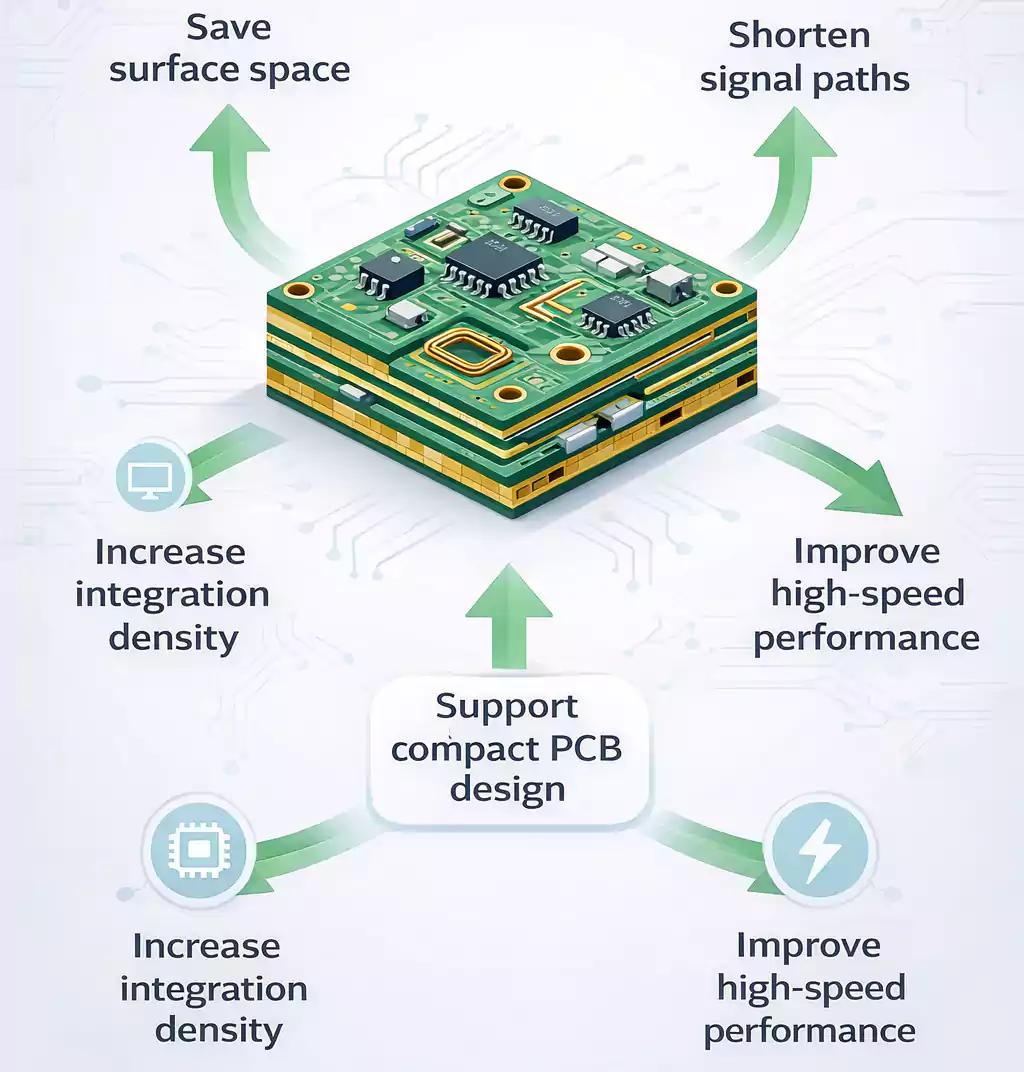
1. They save surface space
By moving some components into the PCB, surface area is freed up for critical devices, connectors, or routing.
2. They increase layout density
Once components are integrated into the board, more functionality can fit into the same footprint, which is especially valuable in compact products.
3. They shorten signal paths
Components placed closer to the associated circuitry usually mean shorter interconnects, which helps reduce parasitic effects.
4. They can improve high-speed and high-frequency performance
In high-speed and high-frequency designs, shorter electrical paths and more compact structures can improve local performance.
5. They increase overall system integration
Embedded components in PCB design allow the board to do more than simply hold parts. The PCB itself becomes part of the circuit, enabling greater miniaturization.
Limitations of Embedded Components in PCB Design
Although PCB-embedded components offer clear advantages, they are not the right choice for every project.
1. Manufacturing is more complex
Compared with standard multilayer boards, embedded component designs require tighter control of lamination, alignment, thickness, and material compatibility.
2. Testing and rework are more difficult
If a surface-mounted component fails, it can often be replaced. But when a component is buried inside the board, inspection and repair become much harder.
3. Costs are usually higher
Because the design and manufacturing processes are more complex, embedded PCB components are usually better suited to high-integration, high-performance, or specialized products rather than standard PCB designs.
A Quick Way to Understand “Formed” vs. “Embedded.”
These two ideas are easy to confuse, but the distinction is actually straightforward.
Formed
“Formed” means the component function is created directly during PCB manufacturing.
Examples:
- Using a resistive material to create a resistor
- Using copper layers and a thin dielectric material to create a capacitor
- Using inner-layer coil patterns to create an inductor
Embedded
“Embedded” means a component that already exists as a separate part is placed between PCB layers.
Examples:
- Embedding an SMT resistor into an inner layer
- Embedding an SMT capacitor into an inner layer
- Embedding certain active devices inside the board
A simple way to remember it:
- Formed = built by process
- Embedded = inserted as a part
Summary
The key takeaways are straightforward:
- Traditional PCBs mainly serve as platforms for component mounting and electrical interconnection.
- PCB embedded components place selected components inside the board rather than only on its surface.
- These components can be either passive or active.
- They are implemented in two main ways:
- Formed: electrical functions are created directly through PCB materials and processes
- Embedded: discrete components are placed between PCB layers
- Common examples include embedded resistors, embedded capacitors, embedded inductors, and SMT components embedded in inner layers.
- Compared with conventional surface-mount designs, embedded components can improve space efficiency, increase integration, and reduce electrical path length.
- Their tradeoff is greater design and manufacturing complexity.
Final Thoughts
PCB embedded components are more than a packaging trend. They represent a broader shift in how PCBs are designed and used.
By integrating embedded passive and active components on the board, designers can improve space efficiency, increase functional density, and support more advanced PCB architectures. These components can be implemented either by embedding discrete components or by integrating electrical functions directly into the PCB structure.
As electronics continue moving toward smaller, faster, and more integrated designs, embedded components in PCB design will remain an important topic for engineers and PCB designers alike.