


EMI shielding protects sensitive electronics from external electromagnetic radiation and helps prevent internally generated interference from escaping into the surrounding environment. In practice, it often relies on conductive or magnetic barriers—such as metal enclosures, gaskets, screens, or coatings—to reflect or absorb unwanted electromagnetic energy and preserve signal integrity.
In electronic product design, equipment integration, and system-level applications, EMI shielding is one of the most practical ways to achieve electromagnetic compatibility (EMC). If a device emits excessive interference or is too susceptible to external noise, it can become unstable, malfunction, or fail in real operating conditions. This article explains the fundamentals of EMI shielding, electromagnetic shielding, EMI vs. EMC, EMS, and EMC design, providing a clear framework for understanding how shielding works and why it matters in modern electronics.
What Are EMC, EMI, and EMS?
1. What is EMC?
Electromagnetic compatibility, or EMC, refers to a device’s ability to operate properly in its electromagnetic environment without causing unacceptable interference to other devices and without being unduly affected by external electromagnetic disturbances.
In other words, EMC is not just about reducing emissions or improving immunity. It is about both. A product must coexist with other systems in the real world.
Why does electromagnetic compatibility matter?
From a product-quality standpoint, electromagnetic compatibility is just as important as safety.
- Safety focuses on protecting people and property.
- EMC focuses on whether electronic devices can operate together reliably and whether they create harmful electromagnetic effects in their surroundings.
A product that performs well in a lab but becomes unstable in an actual operating environment is not truly robust. That is why EMC is such a critical part of engineering design.
2. What is EMI?
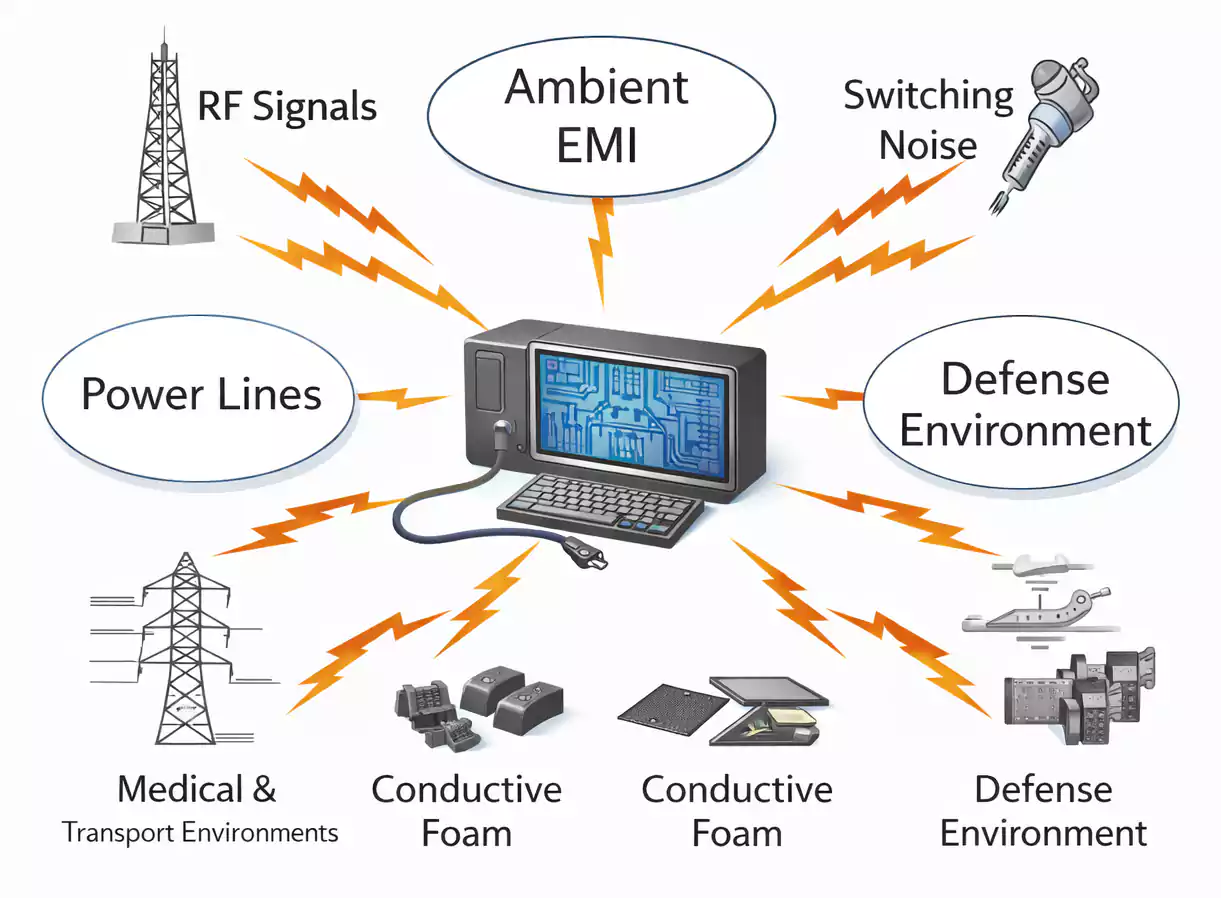
Electromagnetic interference, or EMI, is the unwanted electromagnetic energy generated by components, circuits, devices, or systems that disrupts the normal operation of other equipment.
Put simply, EMI happens when one device becomes a source of interference for another.
3. What is EMS?
Electromagnetic susceptibility, or EMS, describes how sensitive an electronic component or system is to external electromagnetic disturbances.
It reflects how easily a device can be affected by interference, which is why it is closely related to a product’s immunity or anti-interference capability.
4. EMI vs EMC: what is the difference?
A simple way to understand EMI vs EMC is this:
- EMI is the interference itself
- EMC is the broader design goal of controlling that interference while maintaining reliable operation
So EMI is part of the EMC problem. When engineers talk about EMC design, they are usually trying to reduce emissions, improve immunity, and make sure the product performs well in its intended electromagnetic environment.
5. A familiar example: “snow” on a TV screen
A classic everyday example is the “snow” or visual noise that used to appear on television screens.
That kind of distortion indicates that the received signal has been disrupted by interference. It is a simple but effective way to understand that EMI is not just a theoretical concept. It produces real and visible effects in electronic systems.
Why EMI Shielding Reduces Interference
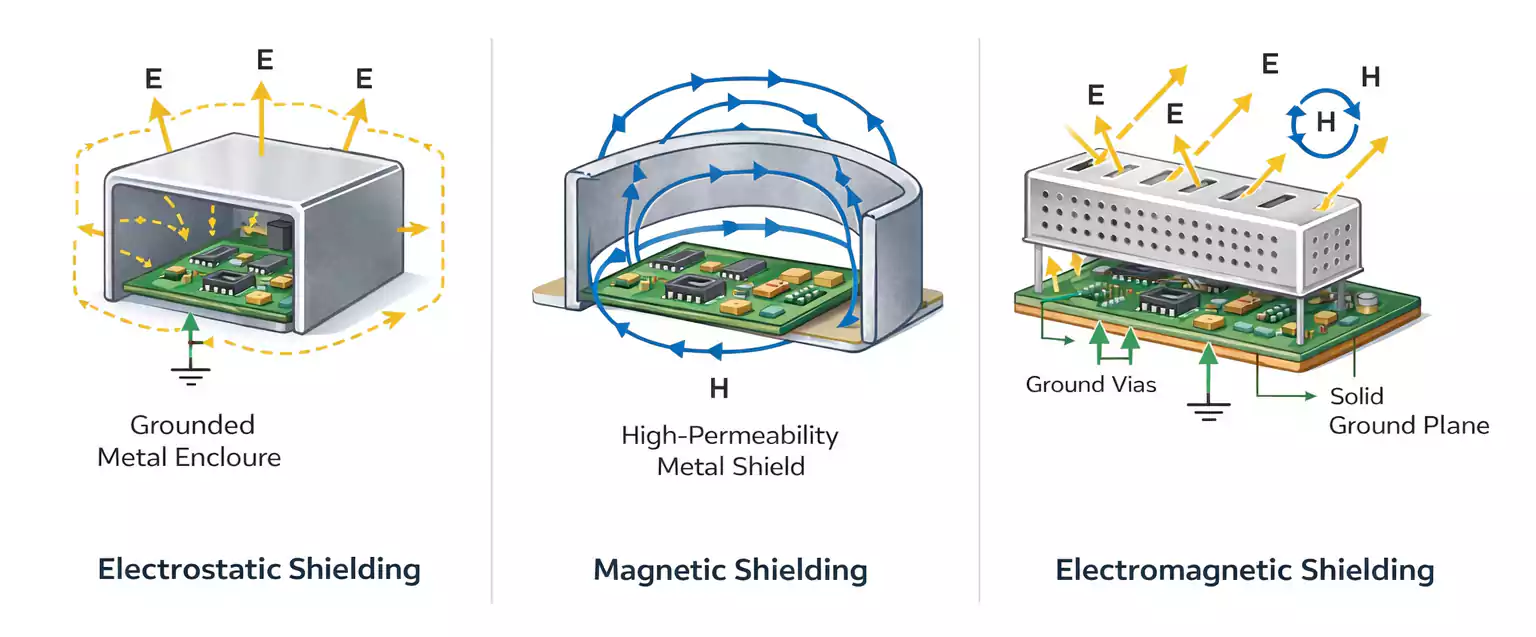
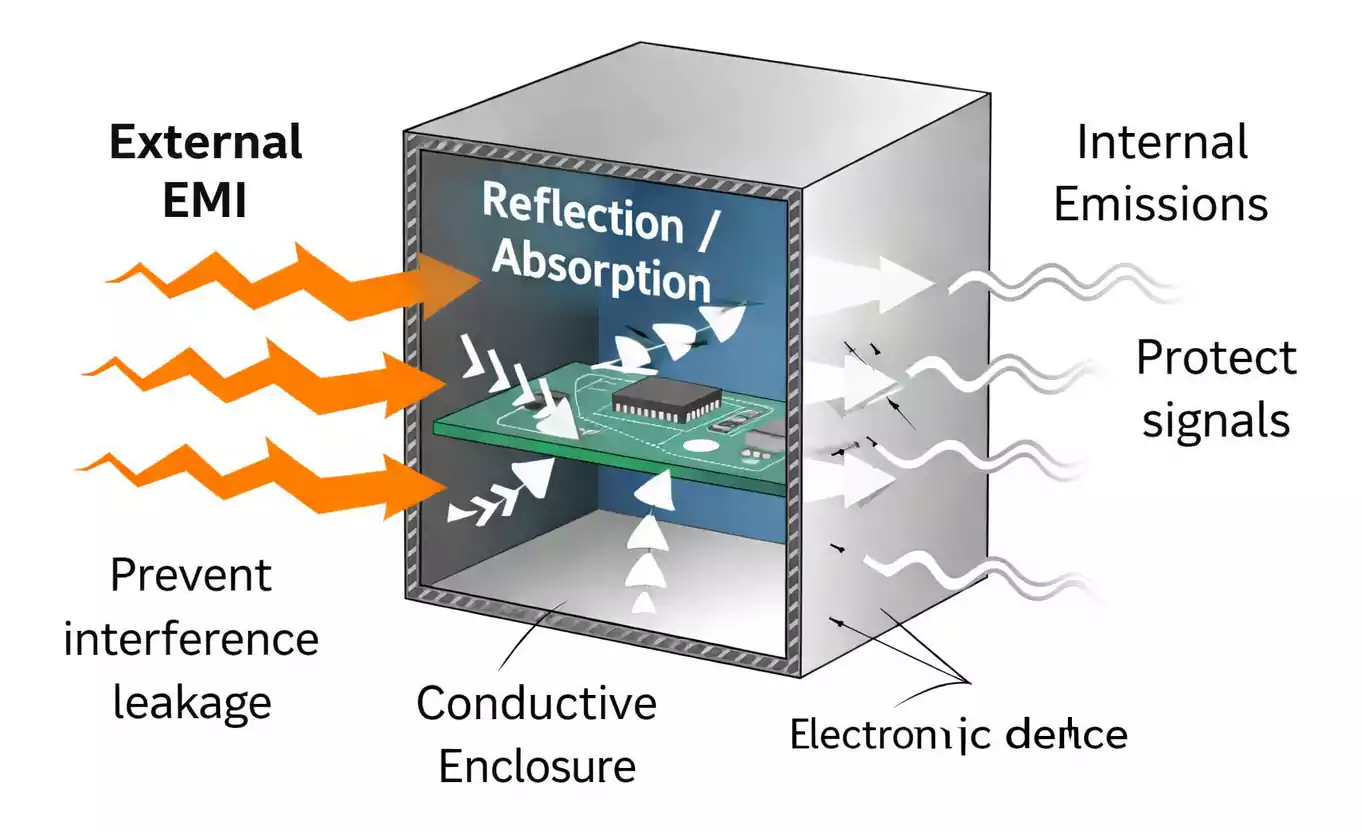
In EMC design, EMI shielding is one of the most common and direct control methods. A shield can weaken external or internal electromagnetic disturbances through three main effects.
1. Energy absorption
A shielding material can absorb part of the electromagnetic energy through eddy-current losses, weakening the wave as it propagates through the material.
2. Energy reflection
When an electromagnetic wave reaches the surface of a shield, part of the wave is reflected because of the impedance discontinuity at the interface between two media, such as air and metal.
3. Energy cancellation
Electromagnetic induction can also generate an opposing electromagnetic field in the shielding layer. This opposing field can partially cancel the interfering field.
So electromagnetic shielding does not work through a single mechanism. Its effectiveness comes from the combined action of reflection, absorption, and partial cancellation.
Electromagnetic Shielding Materials Depend on Frequency
Shielding effectiveness is strongly related to the frequency of the interfering field, which means material selection cannot be one-size-fits-all.
1. High-frequency interference: low-resistivity metals work best
When the interference frequency is relatively high, low-resistivity metals are commonly used for EMI shielding.
The reason is that high-frequency electromagnetic waves more easily induce eddy currents in conductive materials. Those eddy currents create opposing effects that help reduce the incident wave. In high-frequency applications, shielding performance is therefore closely tied to conductivity.
2. Low-frequency interference: high-permeability materials are more effective
When the interference is at a relatively low frequency, ordinary conductive metals are often not enough. In that case, high-permeability materials are preferred.
These materials guide magnetic flux lines into the shielding body and keep them from spreading into the protected space. That means low-frequency magnetic shielding depends more on magnetic permeability than on conductivity alone.
3. Shielding both high and low frequencies: multilayer structures
Some applications require good shielding performance across both high- and low-frequency ranges. In those cases, a single material is often not sufficient.
A common engineering solution is to use multilayer shields made of different metals or magnetic materials, allowing each layer to contribute where it performs best. This is a widely used approach in practical shielding design.
How Electromagnetic Shielding Works
From a physical standpoint, the attenuation provided by a shield mainly comes from reflection and absorption, while multiple internal reflections can further reduce the remaining energy.
1. Surface reflection: the first barrier
When an electromagnetic wave reaches the outer surface of a shield, part of it is reflected because of the impedance mismatch between air and metal.
One important point is that this reflection does not require the material to have a certain minimum thickness. As long as there is an impedance discontinuity at the interface, reflection occurs. In that sense, surface reflection is fundamentally an interface effect.
2. Internal absorption: attenuation inside the material
The portion of the wave that is not reflected at the surface enters the shielding material and continues to propagate forward.
As it moves through the material, its energy is gradually reduced. This is the absorption part of shielding. So a shield not only blocks some energy at the surface, but also dissipates additional energy within the material itself.
3. Multiple reflections: further weakening of residual energy
If some electromagnetic energy still remains after traveling through the shield, it can reach the opposite surface of the material, where it encounters another metal-air impedance discontinuity.
At that boundary, some of the energy is reflected back into the shield. This process can repeat multiple times across interfaces, further weakening the remaining energy.
4. The essence of shielding attenuation
Taken together, electromagnetic shielding reduces wave strength mainly through:
- reflection
- absorption
Multiple reflections can also contribute additional attenuation, especially in certain structures and frequency ranges. Understanding these mechanisms is the key to understanding how EMI shielding actually works.
Some readers may also search for terms like electron shielding effect, but in EMC and electronics design, the more accurate term in this context is usually electromagnetic shielding.
Why EMC Standards Matter
As electronic products have become more widespread, national and international standards for radiated emissions and conducted emissions have become increasingly important.
These standards typically define:
- allowable levels of radiated emissions
- allowable levels of conducted emissions
- in some cases, minimum immunity requirements against different forms of interference
That means EMC is not only about preventing a product from disturbing other devices. It is also about ensuring that the product itself can withstand electromagnetic disturbances in its operating environment.
1. Different products follow different standards
Different categories of electronic equipment are usually subject to different EMC standards. Consumer electronics, industrial systems, communications equipment, and medical devices often have their own testing requirements and compliance limits.
2. Compliance is closely tied to market success
From an engineering and business perspective, meeting electromagnetic compatibility requirements is often essential for a product to succeed in the market. Functionality alone is not enough. A product must also meet the expectations of its electromagnetic environment and the applicable standards for its category.
Where EMI Shielding Is Used
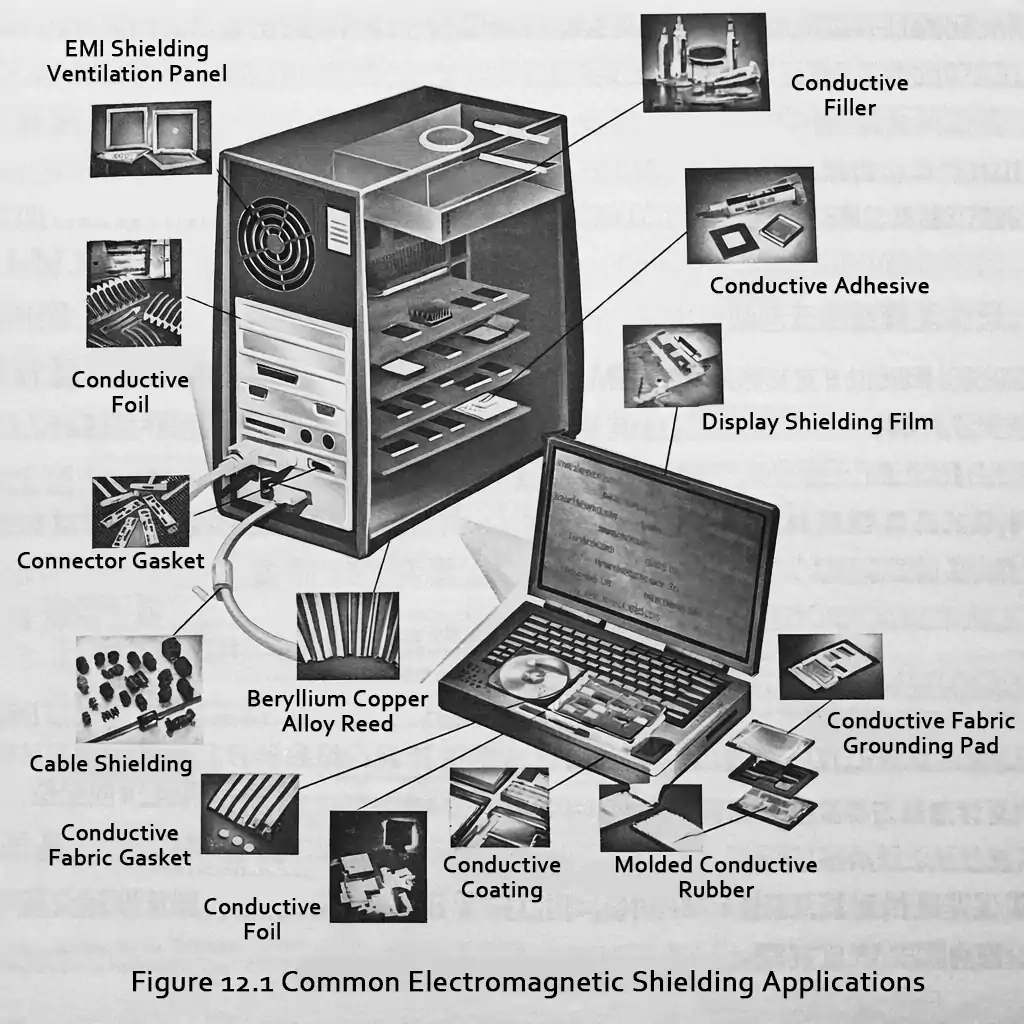
EMI shielding is widely used in electronic products, cables, components, circuit modules, and full systems. Any time there is a risk of electromagnetic interference or when stable operation is required in a noisy environment, shielding may become an important part of the design.
Shielding can be used either to keep outside interference from entering a protected space or to keep internally generated interference from leaking outward.
Active Shielding vs. Passive Shielding
Based on the position of the interference source relative to the shield, shielding structures can be divided into active shielding and passive shielding.
1. Passive shielding
If the purpose of the shield is to prevent an external interference field from entering a protected space, it is called passive shielding.
In this case, the interference source is outside the shield, and the shield is used to block that outside field.
Typical applications
Passive shielding is commonly used when the protected object is relatively far from the interference source, such as in shielded rooms or enclosed shielded spaces. The goal is to isolate the inside from the surrounding electromagnetic environment.
2. Active shielding
If the interference source is located inside the shield and the shield's purpose is to prevent the field from leaking into the surrounding space, it is called active shielding.
In this case, the shield is used to contain internally generated interference.
Key limitation
Active shielding is mainly used for low-frequency applications and is not suitable for high-frequency shielding. That frequency dependence is important when deciding whether this approach is appropriate.
FAQ About EMI Shielding
What is EMI shielding?
EMI shielding uses conductive or magnetic materials to block unwanted electromagnetic interference and protect signal integrity in electronic devices.
Why is EMI shielding important?
It helps electronic products operate reliably by reducing interference that can cause noise, instability, or system failure.
What materials are used for EMI shielding?
Common materials include aluminum, copper, steel, conductive coatings, and shielding gaskets. The best choice depends on frequency, environment, and design constraints.
What is the difference between EMI shielding and EMI filtering?
EMI shielding blocks interference through physical barriers. EMI filtering reduces unwanted noise on power or signal lines using components such as capacitors, inductors, or ferrites.
Can EMI shielding be added to an existing design?
Yes. Shielding can be added with coatings, gaskets, cable shielding, or other retrofit solutions, although it is usually more effective when included early in the design stage.
Conclusion
Electromagnetic interference affects far more than advanced electronic systems. It impacts nearly every type of electronic product, from consumer devices to industrial equipment. Whether it appears as screen noise, system instability, or compliance failures, the root issue often stems from EMC and shielding design.
At a practical level, the key ideas are straightforward: understand the difference between EMI and EMC, know how shielding works through reflection and absorption, and choose materials and shielding strategies based on frequency and application.
In engineering terms, EMC is the goal, and EMI shielding is one of the main ways to achieve it. A solid grasp of these fundamentals helps engineers make better design decisions, reduce interference risks, and solve problems earlier in the development process.