



In electronics manufacturing, soldering is no longer the only practical way to create an electrical connection. As devices become smaller, denser, and more integrated, traditional solder joints can be less suitable in applications that involve heat-sensitive components, fine-pitch designs, or material compatibility challenges. That is why electrically conductive adhesive has become an important option in modern assembly.
A conductive adhesive provides both bonding and electrical conductivity in a single material. After curing, it can secure components while forming a conductive path, making it useful for PCB assembly, fine interconnects, display modules, and other compact electronic applications. In many cases, conductive adhesive for electronics offers a practical alternative to conventional soldering.
This article explains what electrically conductive adhesive is, how it works, the main conductive adhesive types, and the key materials used in a typical conductive adhesive formulation.
What Is an Electrically Conductive Adhesive?
An electrically conductive adhesive is an adhesive that becomes conductive after curing or drying. It is typically made from a resin system with conductive fillers dispersed throughout the material. After curing, these fillers form conductive pathways that allow current to pass through the bonded interface.
Unlike a standard adhesive, a conductive adhesive provides both mechanical bonding and electrical connection in one material. That makes it useful in electronic assembly where components need to be secured while maintaining conductivity.
Compared with traditional soldering, conductive adhesives offer greater processing flexibility. Their curing conditions can be matched to heat-sensitive components and substrates, and they can also be formulated for fine printing or precise dispensing in high-density assemblies.
Why Conductive Adhesives Are Getting More Attention in Electronics
Conductive adhesives are seeing broader use in electronics because they support both performance and manufacturability.
One reason is process flexibility. Their curing conditions can be tailored to heat-sensitive components, flexible substrates, and delicate structures, which makes them a practical option where traditional soldering may introduce too much thermal stress.
They also work well with dispensing, printing, and coating processes. That makes them suitable for fine lines, small pitch, and high-density assembly, all of which are increasingly important in modern electronic designs.
In many applications, conductive adhesives also help simplify processing. For low-temperature joining, fine interconnects, and assemblies that involve dissimilar materials, they offer a practical complement to conventional soldering methods.
Why Conductive Adhesives Can Carry Current
One of the first questions people ask is simple: if it is an adhesive, how can it also conduct electricity?
In general, the conductivity of conductive adhesives comes from two main mechanisms:
- particle-to-particle contact
- electron tunneling across very small gaps
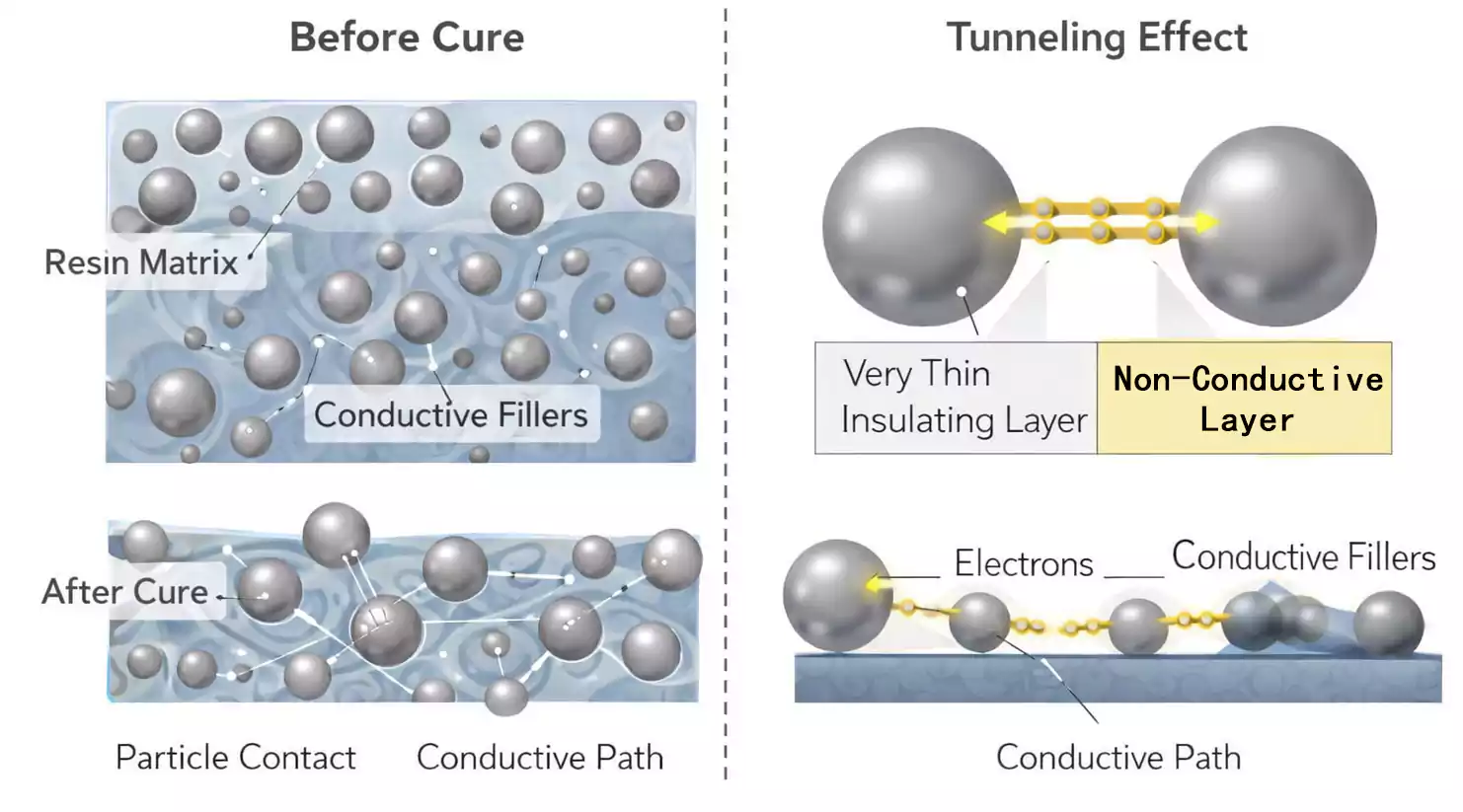
Conductive Paths Formed by Particle Contact
One of the main ways a conductive adhesive carries current is through contact between conductive particles.
Before curing, the particles are dispersed in the resin and do not form a continuous electrical path, so the material behaves more like an insulator. As the adhesive cures or dries, solvent evaporates and the resin shrinks, bringing the particles closer together.
Once enough particles come into contact, they form a stable conductive network. Current then flows through these contact points inside the cured adhesive layer.
This is why electrical performance depends heavily on filler loading, particle shape, particle size distribution, and curing behavior. To conduct reliably, the adhesive must form a stable and continuous particle network.
The Tunneling Effect Also Contributes to Conductivity
Direct particle contact is not the only way a conductive adhesive can carry current. Conductivity can also come from the tunneling effect at very small particle-to-particle gaps.
In some cases, conductive particles are separated by an extremely thin insulating layer rather than being in full contact. When that gap is small enough, electrons can still pass through it and create a conductive path.
The probability of tunneling depends mainly on:
- the thickness of the gap
- the energy barrier between particles
A thinner gap makes tunneling more likely.
This means a conductive adhesive does not always require perfect particle contact to conduct. Even with a very small separation, the material can still show electrical conductivity. From an electrical modeling standpoint, this behavior is often represented as a combination of resistance and capacitance.
Conductive Adhesive Types
Conductive adhesives are usually classified in two ways:
- by conductive direction
- by curing system
1. By Conductive Direction
Isotropic Conductive Adhesive (ICA)
Isotropic conductive adhesive, or ICA, conducts in all directions, including the X, Y, and Z axes.
Because it provides multi-directional conduction, ICA is commonly used in standard electrical interconnection applications where bulk conductivity through the adhesive is required.
Anisotropic Conductive Adhesive (ACA)
Anisotropic conductive adhesive, or ACA, typically conducts only in one direction, most often the Z-axis, while remaining insulating in the X and Y directions.
This makes ACA well suited for fine-pitch and high-density interconnects, where vertical conduction is needed without creating lateral shorts between adjacent lines. It is widely used in display assemblies and other precision electronic applications.
Compared with ICA, ACA usually requires tighter control of materials and processing conditions, so it is better suited for applications where directional conductivity is critical.
ICA vs. ACA at a Glance
| ICA | X, Y, and Z | General electrical interconnection | Multi-directional conductivity |
| ACA | Usually Z-axis only | Fine-pitch and display-related assembly | Vertical conduction without lateral shorting |
2. By Curing System
Another common way to classify conductive adhesive types is by cure method. The main categories are room-temperature, medium-temperature, high-temperature, and UV-curable systems.
Room-Temperature Curable Conductive Adhesives
Room-temperature curable adhesives are useful for heat-sensitive components and substrates because they can be processed at low temperatures. However, their electrical properties may be less stable during storage and use, so process control is important.
Medium-Temperature Curable Conductive Adhesives
Medium-temperature systems are among the most widely used. They typically cure below 150°C and offer a practical balance of electrical performance, mechanical reliability, and process compatibility.
High-Temperature Curable Conductive Adhesives
High-temperature systems are used in some specialized applications, but they require tighter process control. One concern is filler oxidation at elevated temperatures, which can affect performance.
UV-Curable Conductive Adhesives
UV-curable conductive adhesives support fast and localized curing. They are commonly used in display-related and other precision electronic applications where rapid processing is important.
Cure System Comparison
| Room-temperature | Good for heat-sensitive assemblies | Electrical properties may be less stable |
| Medium-temperature | Balanced performance and process compatibility | Requires controlled thermal curing |
| High-temperature | Useful in specialized applications | Higher risk of filler oxidation |
| UV-curable | Fast, localized curing | Best suited to specific process setups |
Conductive Adhesive Formulation: What Conductive Adhesives Are Made Of
A conductive adhesive formulation is a multi-component system rather than a single material. In most cases, it includes:
- a resin matrix
- conductive fillers
- solvents or reactive diluents
- dispersing agents
- other functional additives
Each part has a specific role. The resin provides adhesion and structural support. The fillers create conductive paths. Solvents and diluents improve processability, while additives help control dispersion, flow, bonding, and reliability.
Resin Matrix: Adhesion and Structural Support
The resin matrix is one of the core parts of a conductive adhesive. It largely determines adhesion, mechanical properties, and process compatibility.
Common resin systems include:
- epoxy
- acrylate
- polyurethane
- silicone
- polyimide
- phenolic
- acrylic resins
After curing, the resin forms the structural framework of the adhesive. It holds the assembly together and keeps the conductive fillers in place so the conductive network remains stable.
Although some polymers can conduct to a limited extent, their conductivity is generally too low for reliable electrical interconnection. That is why most conductive adhesive for electronics products rely on conductive fillers rather than the resin itself.
Why Most Conductive Adhesives Are Filler-Based
Most commercial conductive adhesives are filler-based systems. In these materials, conductive particles are added at high enough levels to form a conductive network through particle contact or near-contact effects.
This approach is widely used because it offers a practical balance of conductivity, adhesion, and processability. The resin provides structure and bonding, while the fillers provide electrical performance.
Many of these systems are built on thermosetting resins such as epoxy, silicone, polyimide, phenolic, polyurethane, and acrylics.
Conductive Epoxy and Other Common Resin Systems
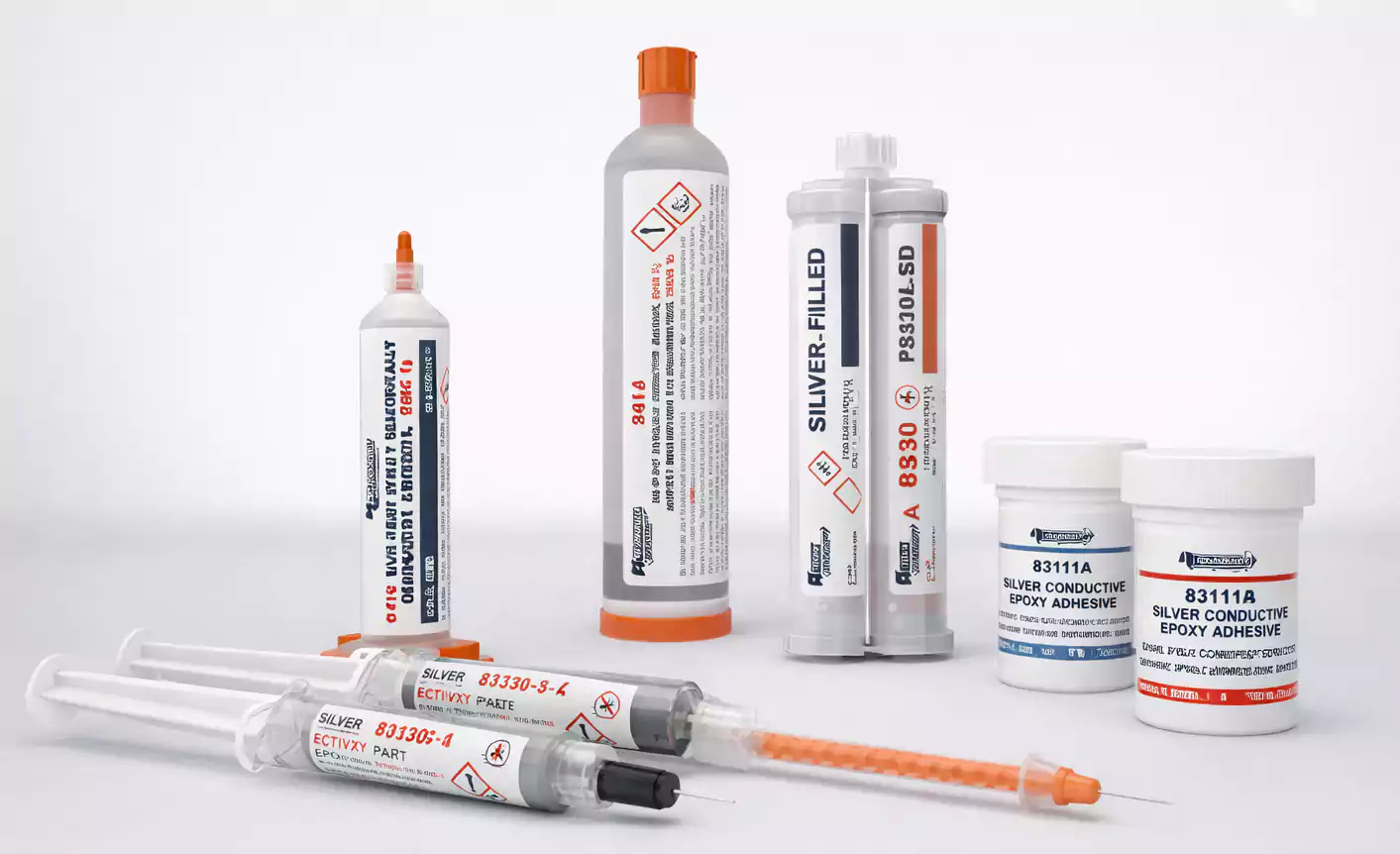
Conductive epoxy remains one of the most common resin systems in this category.
A major reason is processing flexibility. Epoxy systems can often cure at room temperature or below 150°C, making them suitable for many electronics applications. They also allow broad formulation control, including:
- viscosity
- cure speed
- adhesion
- mechanical performance
For applications that require conductivity, reliable bonding, and manufacturability, epoxy remains a leading choice.
Conductive Fillers: The Key to Electrical Performance
The conductive filler is the part of the adhesive that enables current flow.
To perform well, fillers need strong intrinsic conductivity and a suitable particle size distribution. If particle size or dispersion is poorly controlled, the adhesive may not form a stable conductive network.
Common fillers include:
- gold
- silver
- copper
- aluminum
- zinc
- iron
- nickel powders
- graphite
- other conductive compounds
Filler selection typically depends on conductivity targets, oxidation resistance, cost, and application requirements.
Solvents and Reactive Diluents
Many conductive adhesive formulations contain a high filler loading, often above 50%. That can sharply increase viscosity and make the material harder to dispense, print, or coat.
Solvents or reactive diluents are added to improve flow and reduce viscosity. Reactive diluents can also become part of the cured network.
These materials affect more than handling. They also influence cured electrical and mechanical performance, so their type and amount must be carefully controlled.
Dispersants and Other Additives
In addition to resin, fillers, and diluents, conductive adhesives often include additives that improve overall performance.
Common examples include:
- crosslinking agents
- coupling agents
- preservatives
- toughening agents
- thixotropic agents
These ingredients help control curing behavior, filler-resin interaction, flow, toughness, and long-term stability. In practice, a good conductive adhesive is not just conductive. It must also be processable, durable, and reliable.
Where Conductive Adhesive for Electronics Fits in Manufacturing
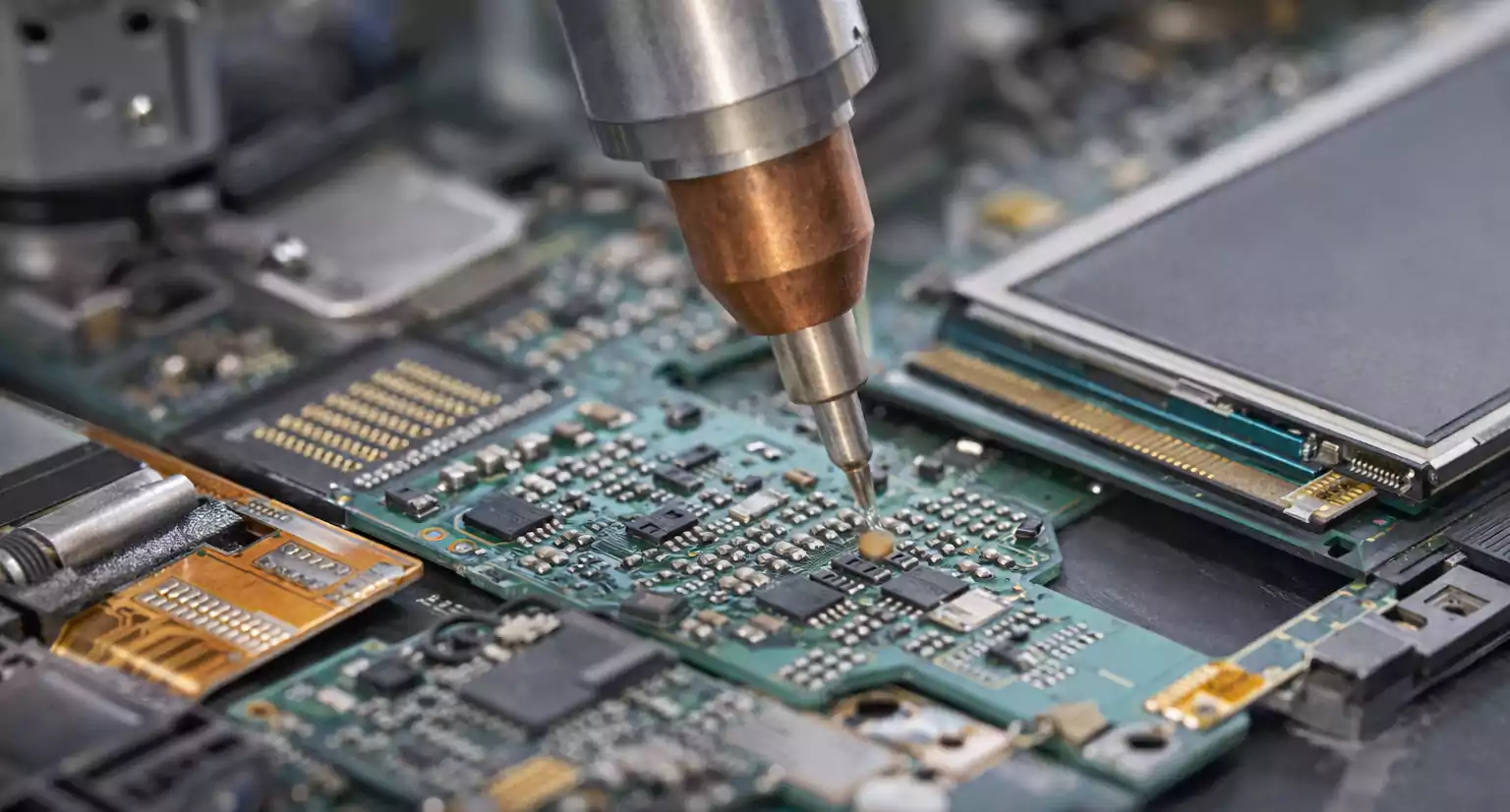
Conductive adhesive for electronics is especially useful in applications where conventional soldering is not the best fit.
Typical examples include:
- temperature-sensitive assembly, where components or substrates cannot tolerate high heat
- fine-pitch and high-density interconnection, where printing or dispensing offers better process control
- display-related applications, especially where anisotropic conductive adhesive is needed for Z-axis conduction without lateral shorting
Rather than replacing solder in every application, conductive adhesives are best viewed as a complementary interconnection solution for lower-temperature processing, finer features, and specialized material combinations.
The Value of Conductive Adhesives Goes Beyond Conductivity
The value of conductive adhesives is not limited to electrical performance alone. They combine bonding, conductivity, process flexibility, and compatibility with compact electronic designs in one material system.
That makes them useful for:
- high-density assembly
- fine interconnects
- lower-temperature processing
- applications that require greater design flexibility
In modern electronics manufacturing, those advantages are often just as important as conductivity itself.
Conclusion
Conductive adhesives combine bonding and electrical performance in one material, which makes them increasingly useful in electronics manufacturing. From isotropic conductive adhesive and anisotropic conductive adhesive systems to different cure methods and material formulations, their value lies in supporting fine interconnects, lower-temperature processing, and high-density assembly.
For PCB, display, and advanced packaging applications, electrically conductive adhesive is not just a material choice. It is a practical interconnection technology for smaller, denser, and more demanding electronic designs.