

Choosing Custom PCB vs Standard PCB is one of the earliest—and most important—engineering and business decisions in any hardware project. The choice affects performance, size, reliability, manufacturability, certification, time-to-market, and total cost across the product lifecycle.
This guide provides a clear, high-accuracy comparison grounded in engineering fundamentals and real industry practices.
What “Standard PCB” Really Means
Search results often mix two meanings of “standard PCB,” so we define them clearly upfront:
Definition A — Standard PCB (Off-the-Shelf Board)
- A ready-made circuit board or development module you can buy immediately.
- Example: sensor boards, MCU/MPU modules, radio modules, dev kits
- Designed for general use, not for a specific product
Definition B — Standard PCB (Standard-Spec Fabrication)
- A PCB manufactured using a fabricator’s standard capabilities.
- Example: FR-4 material, 1–8 layers, common tolerances, standard surface finishes
- Faster, cheaper, and highly repeatable because the factory doesn’t need special processes
What Is a Standard PCB?
A standard PCB is manufactured entirely within typical, widely available capabilities:
- Common materials: Standard FR-4 (Tg 130–150°C), typical dielectric values
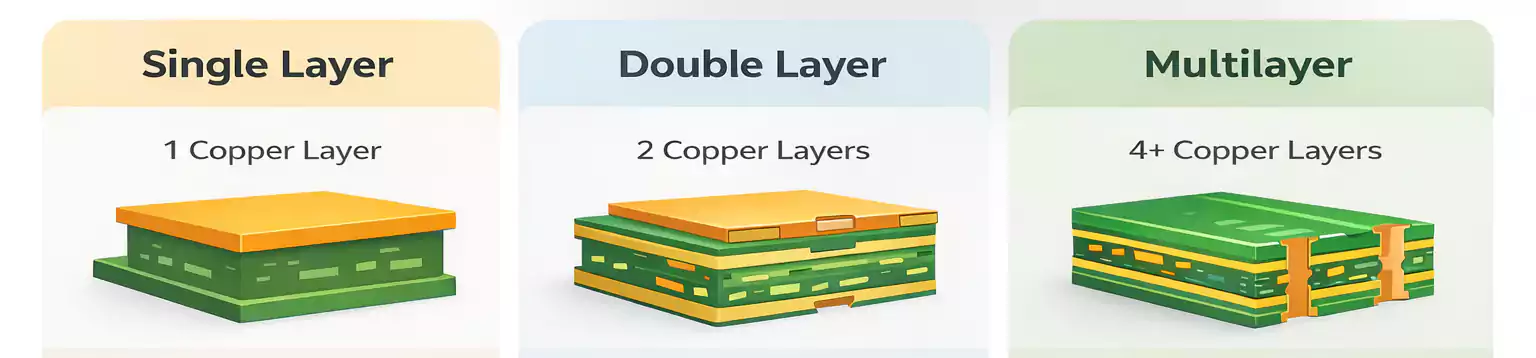
- Standard stackups: 1–8 layers, conventional thickness
- Standard trace/space: ~4–6 mil design rules
- Standard drill sizes: Typical mechanical vias, predictable drill-to-copper clearance
- Standard surface finishes: HASL, lead-free HASL, OSP.
- Typical lead time: Same-day to 5–7 days, depending on the shop
Where standard PCBs shine
- Ideal for prototypes, low-complexity consumer devices, education boards, and simple IoT nodes
- Lower cost and predictable manufacturability
- Excellent for teams validating concepts before committing to high engineering investment
What Is a Custom PCB?
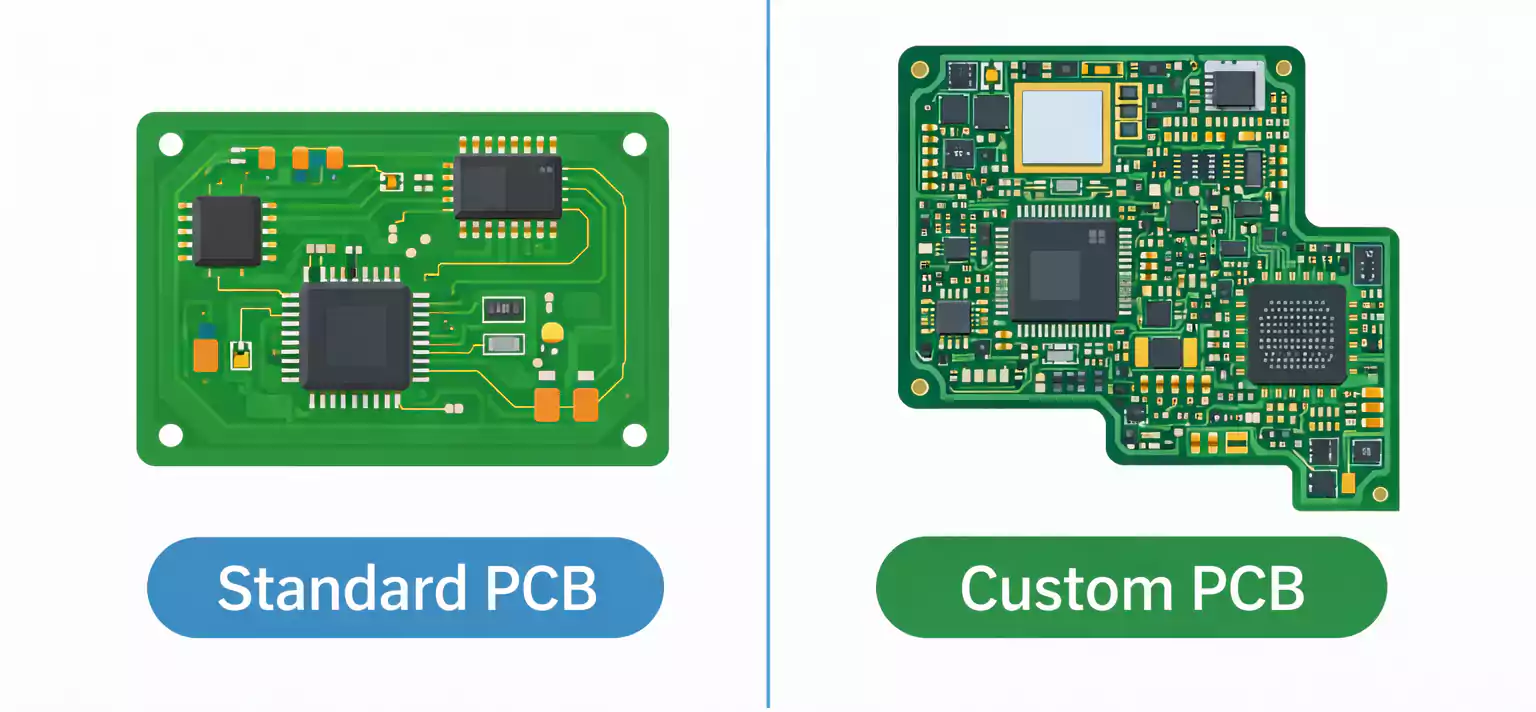
A custom PCB is fully designed per your product’s unique electrical, thermal, structural, and regulatory requirements.
A design qualifies as custom if any of the following apply:
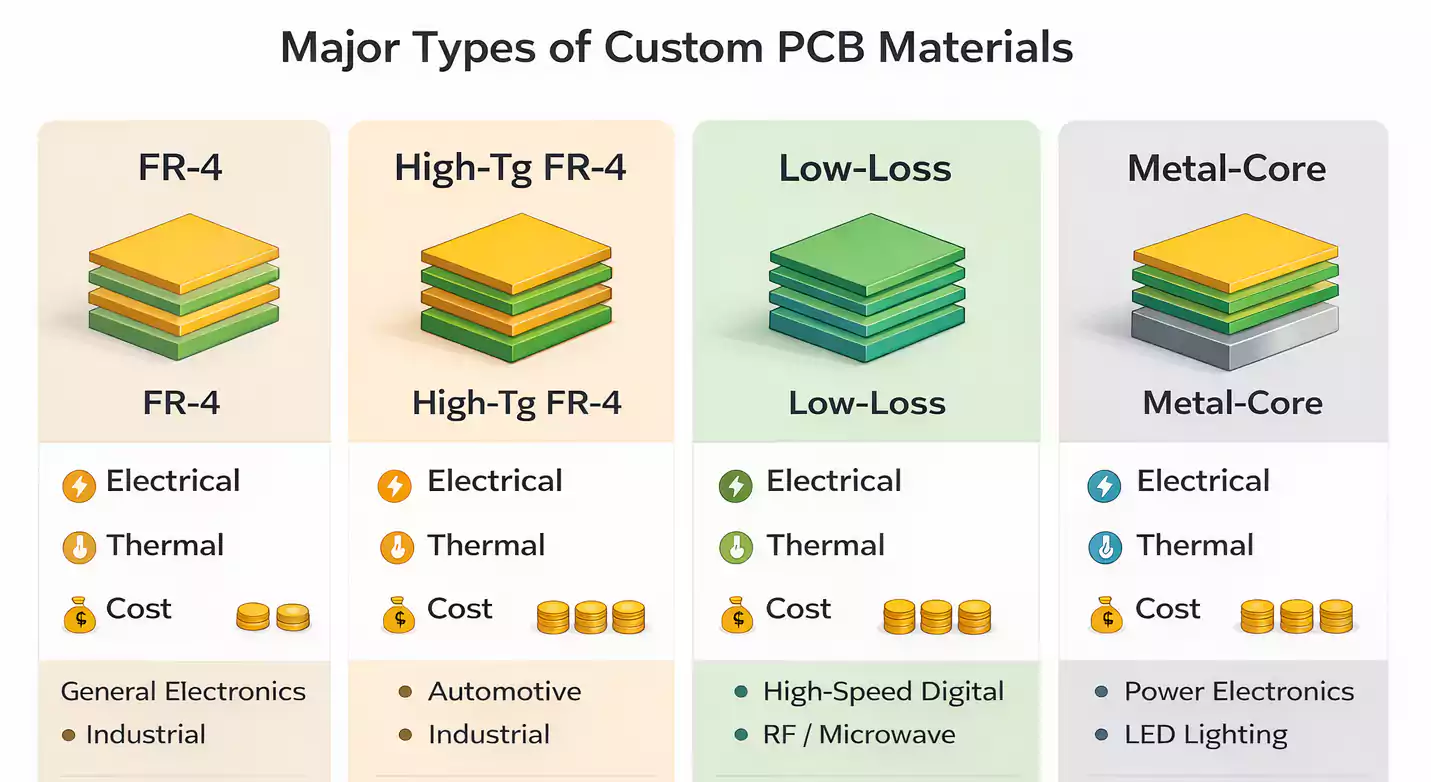
- Specialized materials (Rogers, PTFE, polyimide, aluminum, halogen-free laminates)
- High-speed controlled-impedance routing
- Blind/buried vias, HDI structures, microvias
- Unusual board shape, thickness, copper weight, or flexibility requirements
- Tight tolerances, Class 3 reliability, mission-critical or harsh-environment use
- Integration of RF, high-power, rigid-flex, or multi-board systems
Why engineering teams choose custom PCBs
Custom PCBs give complete freedom: the layout, materials, thermal paths, EMI behavior, form factor, and even assembly process are optimized around your product.
Custom PCB vs Standard PCB at a Glance
| Upfront Cost | Low | Medium–High (engineering, tooling, testing) |
| Unit Cost at Volume | Stable, low | Can be much lower or higher depending on complexity |
| Lead Time | Fast | Longer (special processes, materials) |
| Performance | Adequate for general designs | Optimized for SI/PI, EMI, thermal, RF, power |
| Mechanical Flexibility | Limited | Fully customizable (shape, thickness, rigid-flex) |
| Reliability | Good | Highest when designed to Class 3 or mission-critical specs |
| Certification Path | Standard performance, fewer variables | Easier to design for compliance (FCC, UL, EMC) |
| Mass Production | Simple, stable | Highly optimized, may dramatically reduce BOM or assembly cost |
| Design Freedom | Limited | Unlimited (components, stackup, geometry, routing constraints) |
Benefits of Standard PCBs
Standard PCBs remain the best option for many early-stage and low-complexity products.
1. Lower cost and faster turnaround
Factories complete standard PCBs using existing setups, so:
- Minimal engineering effort
- No special stackups
- No expensive materials
- Faster fabrication time
2. Less manufacturing risk
Since tolerances and processes are well established:
- Fewer production errors
- More predictable yields
- Straightforward DFM/DFT
3. Perfect for prototypes and MVPs
Teams can iterate quickly and cheaply while validating:
- Architecture
- Firmware
- Market demand
- Mechanical concepts
Benefits of Custom PCBs
Custom PCB provides advantages that standard offerings simply cannot.
1. Smaller footprint and reduced product size
By eliminating unnecessary modules and routing density limits, custom PCBs:
- Fit into compact housings.
- Reduce connector count
- Lower thickness and weight
- Improve user experience (wearables, handhelds, medical devices)
2. Superior electrical performance
Critical when the product includes:
- RF (2.4 GHz / 5 GHz / mmWave)
- High-speed interfaces (USB-C, PCIe, DDR, LVDS)
- Low-noise analog stages
- High-power switching
Engineers can tune stackups, routing, grounding, and shielding to meet exact performance needs.
3. Better thermal efficiency
Custom PCBs can integrate:
- Heavy copper
- Thermal vias
- Aluminum substrate
- Coplanar heat spreaders
This is essential for LED lighting, power electronics, motor drivers, and high-current converters.
4. Increased long-term reliability
Custom designs allow:
- IPC Class 3 compliance
- Enhanced solder joint reliability
- Reduced failure points (e.g., fewer connectors)
- Designed-in strain relief and environmental robustness
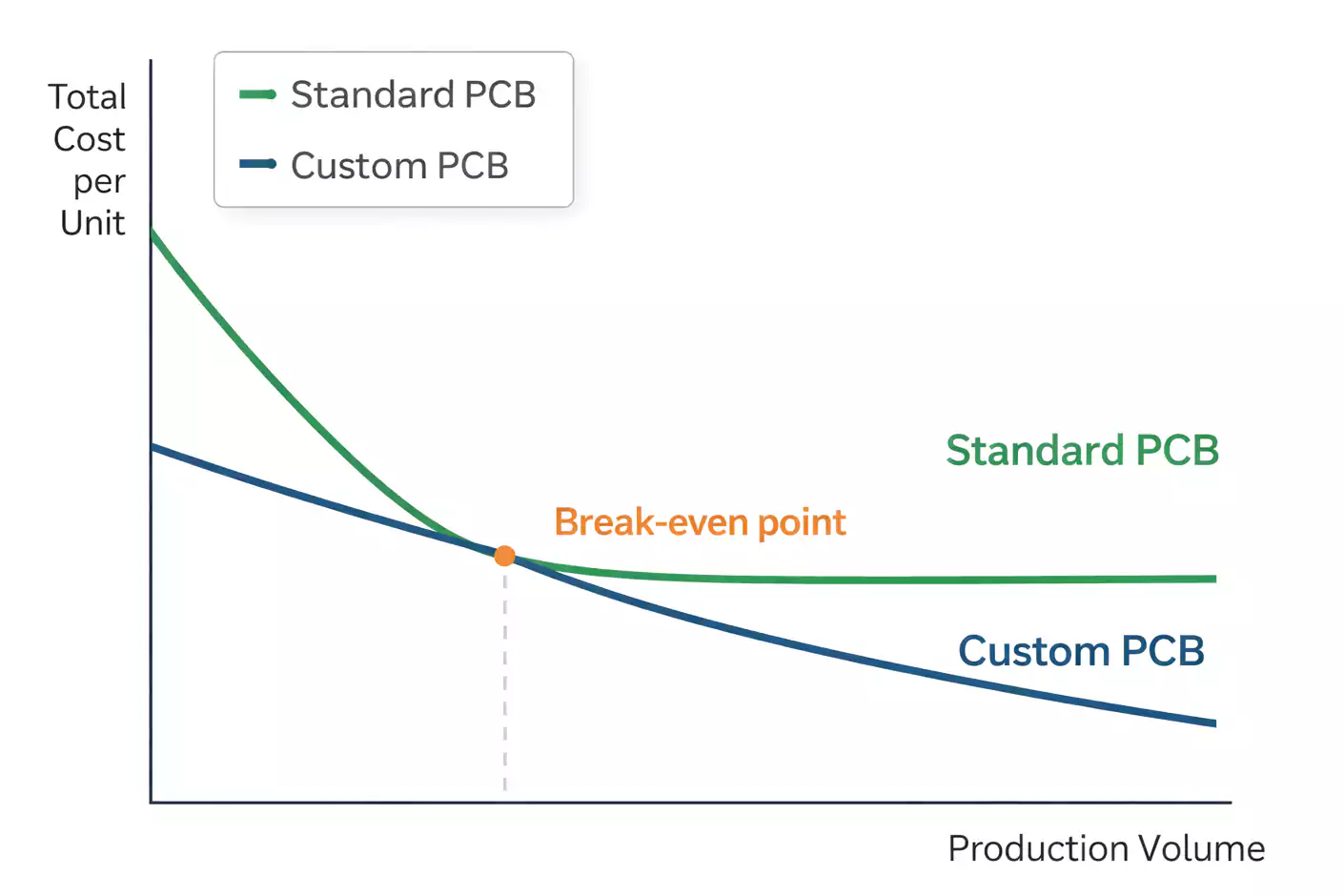
5. Lower cost at medium–high volume
Although custom PCBs have higher upfront engineering costs, they often lower total cost through:
- Reduced BOM
- Streamlined assembly
- Integration of multiple boards into one
- Less rework and field failures
Custom PCB vs Standard PCB Cost
Instead of comparing only the bare PCB price, you should evaluate the Total Cost of Ownership (TCO):
TCO = NRE + (Unit Cost × Volume) + Risk Cost
1. NRE (Non-Recurring Engineering)
Custom PCB NRE includes:
- Electrical/mechanical design
- PCB layout
- Simulation (signal integrity, power integrity, thermal, EMI)
- Prototype runs
- Test fixtures and tooling
- Certification-related redesigns
Typical NRE ranges:
- Low complexity: $5,000–$20,000
- Medium complexity: $20,000–$75,000
- High complexity: $75,000–$150,000+
2. Unit cost
Depends on:
- Layer count
- Material (FR-4 vs Rogers vs aluminum)
- Trace/space rules
- Via structure (HDI, microvia, buried/blind)
- Surface finish
- Required tolerances
3. Risk cost
Neglecting custom requirements can result in:
- EMI failures
- overheating
- mechanical fit issues
- high scrap rate
- expensive redesigns
Conclusion: For small batches, standard PCBs are nearly always cheaper.
For mid- to large-volume applications, custom PCBs are often the more economical long-term choice.
When to Use a Custom PCB
You should seriously consider a custom PCB when any of the following are true:
1. The product must be compact or uniquely shaped
Such as:
- Wearables
- Medical sensors
- Consumer handhelds
2. Performance requirements exceed standard capabilities
Examples:
- RF modules with strict impedance control
- High-speed or low-noise systems
- High-power or thermally constrained systems
3. You need high reliability or harsh-environment durability
Custom PCBs enable controlled materials, thicker copper, or Class 3 reliability.
4. You plan to manufacture at scale
Large production volumes justify investing in:
- Optimized assembly
- Reduced BOM
- More efficient form factors
- Lower long-term failure rates
When a Standard PCB Is the Better Choice
Do not default to a custom PCB too early. A standard PCB is often the smarter path when:
1. You’re building a prototype, MVP, or feasibility test
Rapid iteration beats optimization in early stages.
2. Your product doesn't require unique electrical or mechanical constraints
Basic consumer IoT devices often work fine with standard designs.
3. Time-to-market is critical
Standard boards are manufactured faster and require fewer approvals.
Custom PCB vs Standard PCB Manufacturing
Understanding the difference helps avoid unnecessary cost increases.
Standard-Spec Examples
- 1–8 layers
- FR-4 laminate
- 4–6 mil trace/space
- Standard via sizes
- Standard HASL/OSP finish
- Up to ~2 oz copper
- Standard tolerances
Custom-Spec Examples
- 10–40 layers
- Rogers/PTFE/high-Tg laminates
- Controlled-impedance stackups
- Blind/buried vias, HDI microvias
- ENIG/ENEPIG/immersion silver
- Heavy copper up to 10–20 oz
- Tight mechanical and drilling tolerances
- IPC Class 3 reliability requirements
Common Mistakes When Choosing Custom PCB vs Standard PCB
Avoid these frequent (and expensive) pitfalls:
1. Over-engineering too early
Teams sometimes jump into custom PCBs before architectural decisions are stable. This leads to repeated NRE costs.
2. Underestimating signal integrity, EMI, or thermal needs
A design that works on a dev board can fail spectacularly in a compact enclosure.
3. Locking into modules that cannot scale
Off-the-shelf boards often artificially inflate BOM and enclosure size when transitioning to production.
4. Ignoring certification requirements early
FCC, CE, and UL issues often stem from PCB stackup and grounding choices—not enclosure mistakes.
5. Not considering supply chain longevity
Modules and standard boards sometimes become obsolete quickly; custom PCBs offer more control.
FAQ
Is a custom PCB always more expensive?
Upfront, yes, but at volume, custom PCBs can reduce unit cost and improve reliability, lowering long-term expenses.
How do I know when a custom PCB investment is worth it?
If you care about product size, thermal behavior, EMI, RF performance, or volume production, custom PCBs almost always justify the investment.
Do custom PCBs take longer to manufacture?
Usually yes—especially if materials, stackups, or via structures fall outside standard capabilities.
Is it possible to start with standard boards and transition to custom later?
Yes, and many teams follow this path:
Prototype → Standard PCB → Custom PCB → Mass production
Conclusion
Both standard and custom PCBs have their place. Standard PCBs deliver speed, affordability, and simplicity—ideal for early development or simpler products. Custom PCBs unlock higher performance, smaller size, greater reliability, and lower long-term cost for scalable, high-quality production.
If you need engineering-driven PCB fabrication with fast turnaround and professional guidance, FastTurnPCB offers custom and standard-spec PCB solutions built for high efficiency and real-world manufacturability.