

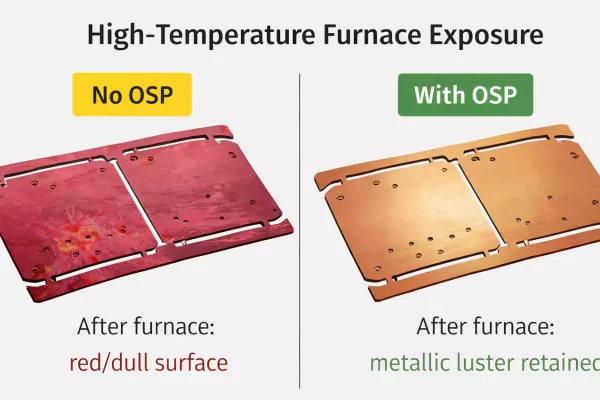
Copper-based PCBs are widely used in LED lighting, power electronics, automotive modules, and other high-thermal applications due to their excellent heat dissipation. However, manufacturers and customers often encounter a frustrating issue: after passing through a high-temperature furnace or a reflow process, the copper base surface may turn reddish or darker, or lose its metallic luster.
This discoloration is often misinterpreted as a material defect or a quality issue. In reality, it is typically a surface oxidation phenomenon. Understanding why copper-base discoloration occurs — and how OSP (Organic Solderability Preservative) treatment helps control it — is essential for improving appearance consistency, solderability, and overall manufacturing stability.

What Causes Copper Base Discoloration After a High-Temperature Furnace?
Copper is a highly reactive metal. When exposed to oxygen and moisture, it naturally forms oxide layers. At room temperature, this oxidation process is relatively slow. However, when copper is subjected to high-temperature furnace exposure — such as during reflow soldering or other thermal processing — oxidation accelerates significantly.
For copper-based PCBs, several factors contribute to visible discoloration:
1. High Temperature Accelerates Oxidation
Heat increases the reaction rate between copper and oxygen. During furnace processing, exposed copper surfaces can oxidize rapidly, forming copper oxide layers that alter the surface color.
2. Large Exposed Copper Areas
Unlike standard FR-4 boards, where copper is mostly covered by solder mask and surface finishes, copper base PCBs often have larger exposed copper areas for thermal conduction. These surfaces are more visible and more susceptible to noticeable color changes.
3. Lack of Surface Protection
If the copper base is not properly protected before entering high-temperature processes, oxidation occurs directly on the bare copper surface. The result is a reddish or darkened appearance after the furnace stage.
4. Surface Contamination or Inadequate Pre-Treatment
Residues, fingerprints, poor cleaning, or poor micro-etch control can accelerate oxidation. Even small contamination can worsen discoloration during heating.
In short, copper discoloration after a high-temperature furnace is primarily a surface oxidation issue—not necessarily a structural or material failure.
Is Discoloration Only a Cosmetic Issue?
This is an important question.
In many cases, mild discoloration is mostly cosmetic. The copper has oxidized slightly, but solderability may still be fine. More severe oxidation, though, can cause:
- Reduced solder wetting
- Inconsistent solder joint formation
- Increased risk of assembly defects
- Narrower process windows
The distinction depends on the thickness and uniformity of the oxide layer. Thin oxide layers may only affect appearance. Heavier oxidation can interfere with reliable metallurgical bonding during soldering.
What Is OSP and How Does It Protect Bare Copper?
OSP (Organic Solderability Preservative) is a surface treatment designed specifically to protect exposed copper surfaces.
Unlike metallic finishes such as ENIG (Electroless Nickel Immersion Gold), OSP is an organic coating. It forms a very thin, uniform protective film on the copper surface.

How OSP Works
- The copper surface is cleaned thoroughly.
- A controlled micro-etch process prepares the surface.
- The OSP solution is applied.
- A thin organic film chemically bonds to the copper.
This protective layer acts as a barrier, reducing direct exposure to oxygen and moisture during storage, handling, and pre-assembly stages.
The key advantage is that OSP protects copper from oxidation before soldering, but during reflow, the organic layer decomposes, allowing solder to wet fresh copper underneath.
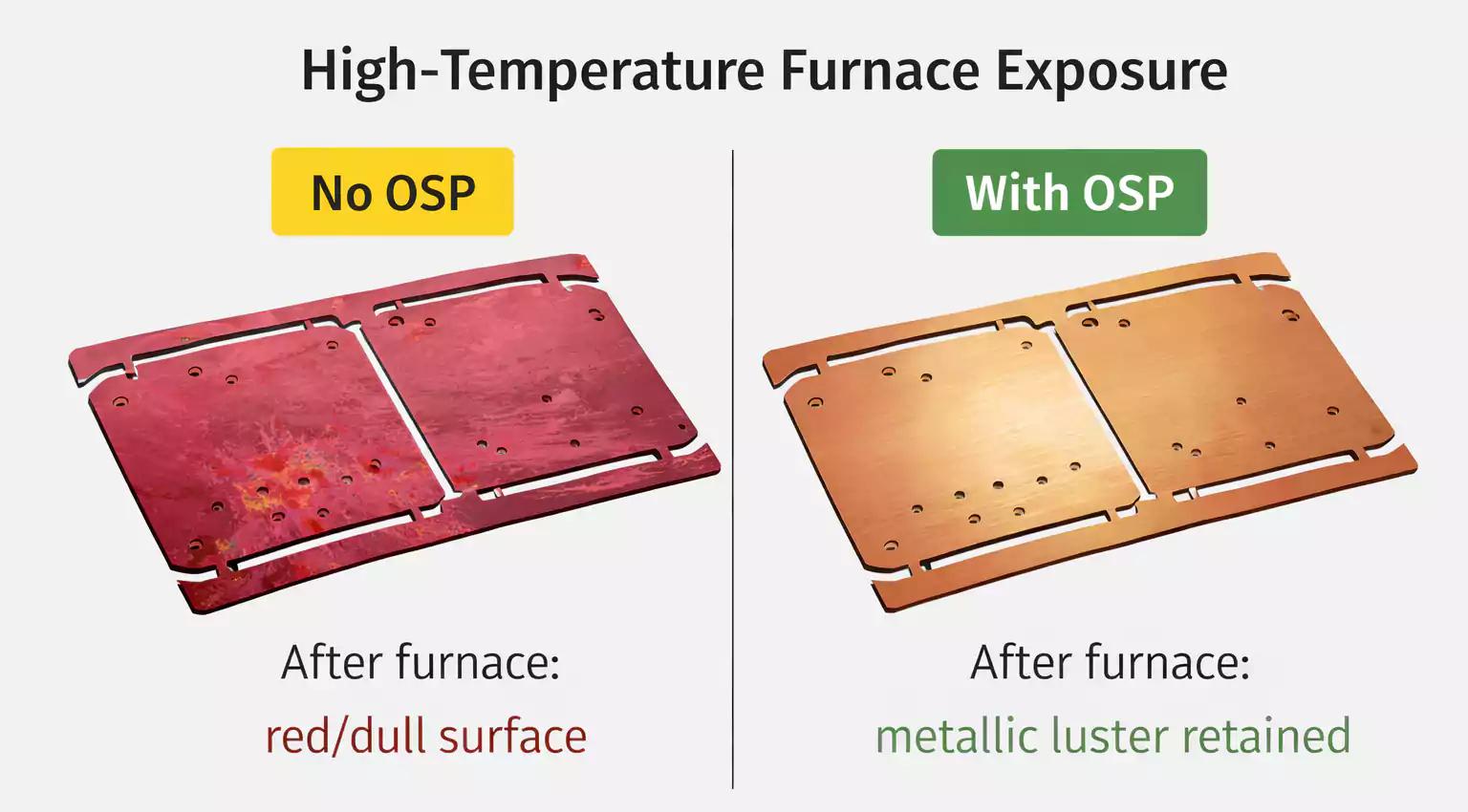
Copper Base with OSP vs Without OSP: What Changes After Furnace Exposure?
When comparing copper base PCBs processed through a high-temperature furnace:
Without OSP:
- The copper surface is directly exposed to air.
- Oxidation occurs more aggressively during heating.
- The surface may turn reddish or darker.
- Metallic luster decreases.
- Appearance consistency between panels may vary.
With OSP:
- The copper surface is protected before furnace exposure.
- Oxidation is significantly reduced.
- Surface color remains more uniform.
- Metallic appearance is better preserved.
- Overall cosmetic quality improves.
The difference is often visually obvious. While OSP does not completely eliminate color changes under extreme conditions, it dramatically reduces the severity and variability of discoloration.
Main Advantages of OSP for Copper Base PCBs
When properly controlled, OSP offers several benefits:
1. Effective Oxidation Control
The primary benefit is reduced copper oxidation prior to assembly and during moderate thermal exposure.
2. Excellent Surface Flatness
Because OSP does not deposit thick metal layers, it preserves the original copper geometry. This flat surface supports fine-pitch components and consistent solder paste printing.
3. Good Initial Solderability
The protective layer preserves copper until reflow. When heated, the layer breaks down, allowing solder to bond to clean copper.
4. Cost Efficiency
OSP is generally more cost-effective than noble metal finishes. For cost-sensitive copper base applications, it provides a practical balance between protection and budget.
5. Environmentally Friendly
OSP processes are typically free of heavy metals, aligning well with modern environmental standards.
Limitations of OSP You Should Know
While OSP is effective, it is not a universal solution.
1. Limited Shelf Life
OSP-coated boards generally have a shorter storage window than metal finishes such as ENIG. Extended storage can reduce protection effectiveness.
2. Sensitivity to Handling
The thin organic film can be damaged by excessive handling, fingerprints, or mechanical abrasion.
3. Thermal Cycling Sensitivity
Multiple high-temperature cycles, excessive baking, or repeated rework can degrade the protective layer.
4. Storage Requirements
Proper packaging and humidity control are essential. Poor storage conditions can compromise OSP performance.
Why Some OSP-Treated Copper Base Boards Still Change Color
Even with OSP treatment, discoloration may still occur under certain conditions. Common causes include:
1. Insufficient Surface Cleaning
If residues remain before OSP application, film adhesion may be inconsistent.
2. Poor Micro-Etch Control
Micro-etching prepares the copper surface. If under-etched or over-etched, film formation may be uneven.
3. Uneven Film Thickness
Non-uniform coating can lead to localized oxidation during furnace exposure.
4. Excessive Thermal Exposure
Multiple reflow cycles or unusually high furnace temperatures can overwhelm the protective layer.
5. Contamination After OSP
Improper handling after coating can compromise surface protection.
These issues highlight that OSP effectiveness depends not only on choosing the finish but also on strict process control.
Best Practices to Reduce Oxidation and Discoloration on Copper Base PCBs
To maximize protection and minimize discoloration:
- Ensure thorough surface cleaning before OSP application.
- Maintain consistent micro-etch parameters.
- Control OSP solution concentration and application time.
- Minimize the delay between fabrication and assembly.
- Use moisture-controlled packaging.
- Avoid unnecessary baking unless it's required.
- Limit repeated high-temperature cycles when possible.
By combining proper OSP treatment with disciplined process control, manufacturers can significantly reduce oxidation-related variability.
When Is OSP a Good Choice for Copper Base PCBs?
OSP is particularly suitable when:
- Cost control is important.
- Surface flatness is critical.
- Assembly occurs shortly after fabrication.
- Appearance consistency matters.
- The product does not require extended long-term storage.
However, if boards must endure long storage periods, harsh environmental conditions, or multiple rework cycles, alternative finishes may be necessary.
Conclusion
Copper discoloration on a base discoloration after high-temperature furnace exposure is fundamentally a copper oxidation issue. OSP offers a practical and cost-effective way to protect exposed copper, stabilize appearance, and maintain solderability before assembly. Its effectiveness, however, depends on proper surface preparation, coating control, and storage conditions.
When used within its process limits, OSP remains a reliable default finish for many copper-based PCB applications.
FastTurnPCB applies strict process control to ensure consistent OSP performance and high-quality copper base PCB manufacturing.