


A PCB board prototype can mean two different things depending on who is searching.
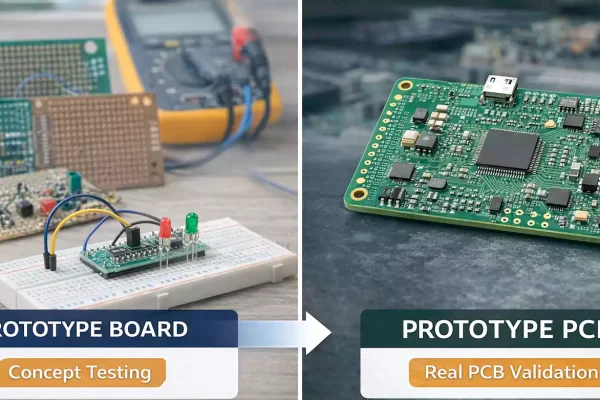
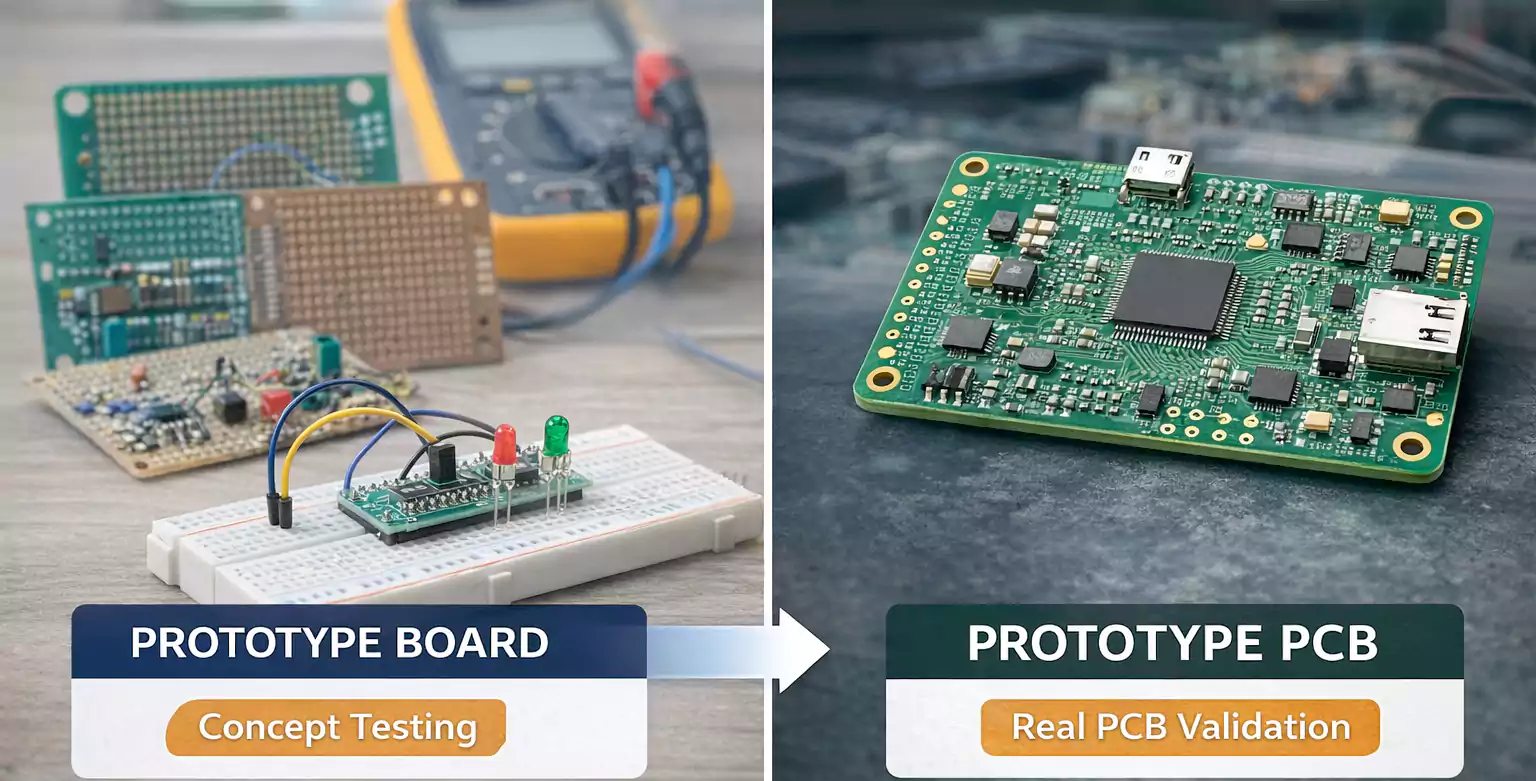
For hobbyists or early-stage testing, it may mean a prototype board, such as a perf board or stripboard, for hand-soldered circuits. In product development, though, it usually means a fabricated prototype PCB—a real board made from design files so engineers can test layout, stackup, assembly, fit, and performance before mass production.
That difference matters. Many people start with a simple board for concept testing, then realize they need something much closer to the final product. This guide explains the difference, shows when each option makes sense, and helps you decide when it is time to move to rapid PCB prototyping.
Quick Overview
- Use a breadboard for quick, temporary circuit testing.
- Use a prototype board when you want a more stable hand-built version of a simple circuit.
- Use a prototype PCB to verify real-world performance, fit, manufacturability, or assembly.
- Choose rapid PCB prototyping when your project moves quickly, and you need fast design iterations.
What Is a PCB Board Prototype?
A PCB prototype is an early version of a circuit board used to test whether a design works before committing to full production.
In practice, the term usually covers two different things.
1. Prototype board for manual builds
This includes common boards like:
- Perf board, where each hole has its own isolated copper pad
- Stripboard, where holes are connected by copper strips that can be cut as needed
These boards are useful for simple experiments, educational projects, and one-off circuits. They are quick to use and easy to modify, which makes them a practical step after a breadboard.
They are not, however, a substitute for a real PCB. They do not reflect actual copper routing, stackup, drilled hole tolerances, or assembly conditions.
2. Fabricated prototype PCB
This is a real printed circuit board manufactured from your design data. It includes defined layers, copper thickness, drill sizes, materials, solder mask, and surface finish.
A fabricated prototype PCB board is much closer to the final product. It lets you test not only whether the circuit works, but also whether the board can be manufactured, assembled, and used the way you intended.
Prototype Board vs. Breadboard vs. Prototype PCB
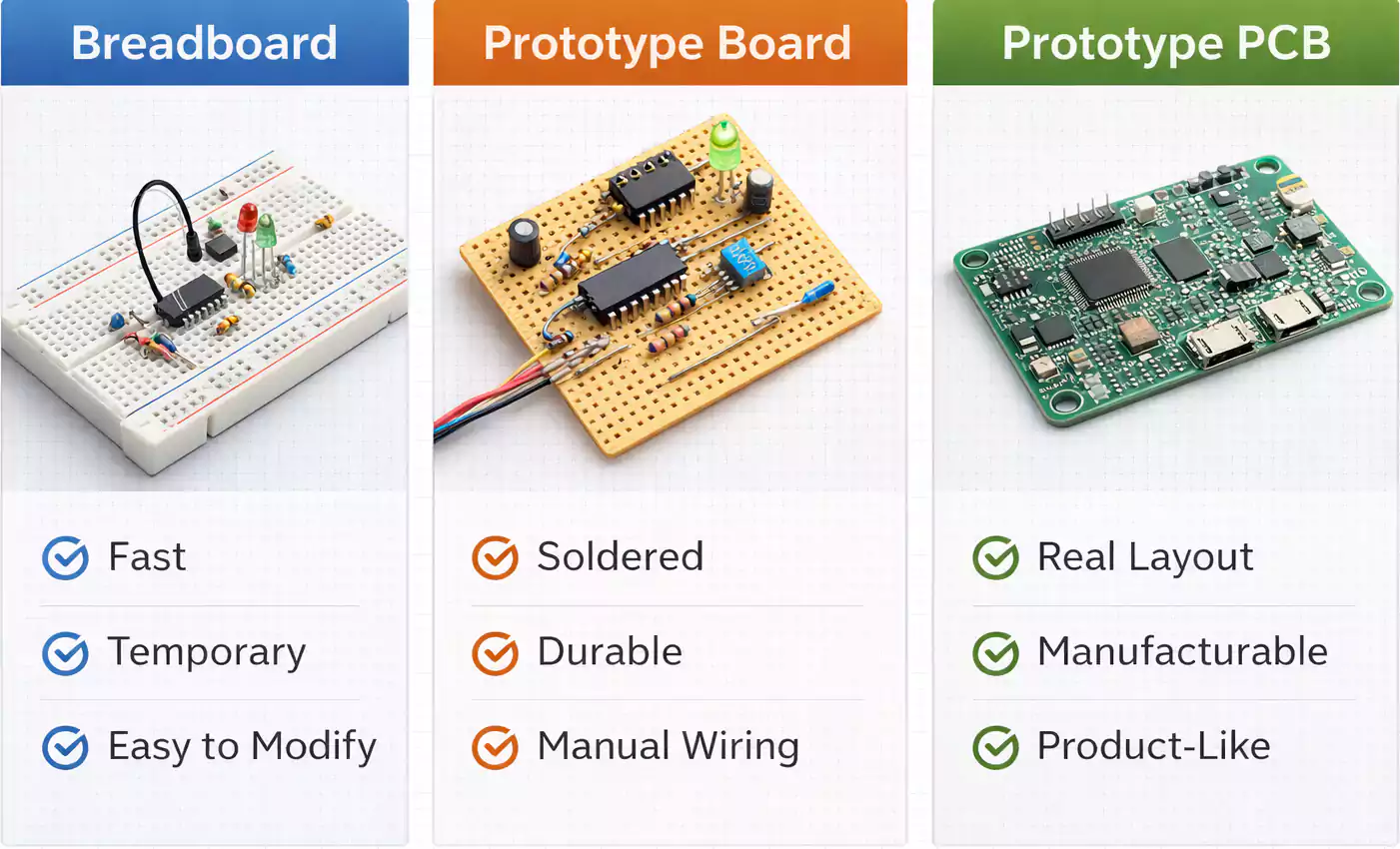
These three options are related but not interchangeable.
| Breadboard | Solderless temporary board | Early proof-of-concept testing | Not stable or representative of the final product |
| Prototype board | Hand-soldered perf board or stripboard | Simple, more durable circuit testing | Still does not reflect a real PCB build |
| Prototype PCB | Manufactured board from design files | Real validation of layout, fit, and assembly | More time and cost than simple test methods |
1. Breadboard
A breadboard is often the fastest way to test a new idea. You can easily move parts around, try different values, and make changes in minutes. That flexibility makes it ideal for early experiments.
The downside is that breadboards are inherently temporary. Connections are less secure, electrical behavior is less predictable, and they do not reflect how the final board will perform.
2. Prototype board
A prototype board sits in the middle. It gives you a more solid, soldered version of the circuit and is often a better choice once the design is stable enough to move beyond a breadboard.
Perf board gives you more freedom in wiring. Stripboard can make simple layouts faster if the copper strips happen to match your routing needs.
Still, both are manual solutions. They are useful for basic functional testing but not for validating a real PCB layout.
3. Prototype PCB
A fabricated prototype PCB is the right step when you need answers that only a real board can provide.
That includes questions like:
- Will the routing behave as expected?
- Does the board fit the enclosure?
- Are the connector positions correct?
- Will the assembly process work smoothly?
- Is the thermal design good enough?
If those questions matter, a real prototype PCB is usually the better tool.
Why PCB Prototyping Matters Before Production
A prototype is not just an early sample. It is a way to reduce risk before scaling up.
Skipping prototyping may save time at first, but it often leads to more costly problems if production is the first real test.
Here is what a prototype helps you validate.
1. Electrical performance
A circuit that looks correct in CAD or simulation can still behave differently on a real board.
A fabricated prototype helps verify:
- signal routing
- grounding and return paths
- power integrity
- impedance-related behavior
- noise and interference issues
This is especially important in higher-speed, higher-density, or mixed-signal designs.
2. Stackup and material choices
Board thickness, dielectric properties, layer arrangement, and copper weight all affect performance.
A real prototype lets you confirm whether those design choices actually work in practice, not just in theory.
3. Mechanical fit
Many problems only appear when the board is in your hands.
A prototype can reveal:
- connector misalignment
- enclosure fit issues
- hole placement problems
- clearance conflicts
- poor component spacing
Even a minor dimensional issue can cause major delays if discovered too late.
4. Thermal behavior
Heat is another area where prototypes matter.
Real hardware shows whether:
- Copper pours are doing enough.
- thermal vias are effective
- hotspots appear under load
- sensitive parts are too close to heat sources
These problems are much easier to fix during prototyping than after production begins.
5. Manufacturability
A good prototype also helps uncover DFM issues early.
That might include:
- hole sizes that are too aggressive
- solder mask openings that are too tight
- traces or clearances that create yield risk
- assembly challenges around dense components
Catching those issues early can save both time and money.
When to Choose Rapid PCB Prototyping
Not every project needs an ultra-fast turnaround. But when schedules are tight, rapid PCB prototyping can make a big difference.
It is especially useful when:
- The design is changing quickly.
- Multiple revisions are expected.
- firmware bring-up depends on hardware availability
- A customer sample or demo deadline is near.
- A component substitution forces a board update.
- The project is in EVT, DVT, or another validation stage.
In these cases, speed is often more valuable than achieving the lowest possible board cost.
What “quick turn” really means
A quick-turn prototype PCB usually means the supplier is set up to move the job through fabrication quickly. But actual lead time still depends on the board itself.
Turnaround is affected by factors such as:
- layer count
- drill complexity
- board thickness
- material availability
- surface finish
- impedance requirements
- special process needs
A simple two-layer or four-layer board may move very fast. A more complex design with specialty materials or tighter tolerances may still qualify for fast service, but not at the same speed.
When comparing quick-turn options, it is important to look beyond the headline promise and understand what the quoted lead time actually includes.
Prototype PCB vs. Full Production PCB
Prototype and production boards are part of the same development path, but they are built for different purposes.
1. Prototype PCB
A prototype is about learning. Its job is to validate the design, reveal problems, and guide the next revision if needed.
Prototype builds are typically:
- low volume
- more flexible
- faster moving
- focused on engineering feedback
- meant to support iteration
2. Full production PCB
Production is about consistency. Once the design is proven, the focus shifts from learning to repeatability.
Production builds are designed for:
- stable manufacturing
- higher yield
- better cost control
- consistent quality
- long-term supply planning
Here is the difference at a glance:
| Main goal | Validate the design | Manufacture reliably at scale |
| Quantity | Low volume | Higher volume |
| Design status | Still evolving | Mostly fixed |
| Priority | Speed and feedback | Consistency and efficiency |
| Cost per board | Higher | Lower at scale |
How to Choose the Right Prototype PCB Solution
The best prototyping path depends on what you need to learn from the build.
1. Functional proof
If the goal is simply to check whether a basic circuit idea works, a breadboard or prototype board may be enough.
2. Product-level answers
If you need to confirm any of the following, a fabricated PCB is usually the better choice:
- layout quality
- actual board dimensions
- connector positions
- signal behavior
- thermal performance
- assembly readiness
- manufacturability
At that point, hand-built boards stop being very useful because they no longer answer the most important questions.
What to look for in a prototype PCB supplier
A good prototype partner should support the things your board actually needs, such as:
- the right layer count
- suitable materials
- correct copper weight
- appropriate finishes
- realistic drill and feature capability
- DFM or CAM feedback
- assembly support if required
If you need finished boards rather than bare boards, check whether the supplier also offers prototype PCB assembly. That can save time and make debugging easier, especially on denser designs.
What to Prepare Before Ordering a Prototype PCB
A prototype order goes much more smoothly when the requirements are clear.
Before placing the order, make sure you have the following ready.
1. Core design data
- Gerber or ODB++ files
- drill files
- board outline and dimensions
- fabrication notes
- stackup details
2. Key technical requirements
- layer count
- copper weight
- material type
- board thickness
- impedance requirements, if any
- surface finish
- tolerance expectations
3. If assembly is needed
- BOM
- pick-and-place data
- assembly drawing
- polarity notes
- Any special instructions for soldering or testing
FAQ About PCB Board Prototypes
What is a PCB prototype?
A PCB prototype is an early board build used to test and validate a design before full production. It may be a hand-built prototype board, but in engineering, it usually refers to a real manufactured PCB.
Is a prototype board the same as a breadboard?
No. A breadboard is solderless and temporary. A prototype board is usually soldered and more stable. A fabricated prototype PCB goes one step further by reflecting actual manufacturing conditions.
When should I move from a breadboard to a real prototype PCB?
You should move when board layout, signal performance, fit, thermals, or assembly start to matter. If you need results that are close to the final product, a real prototype PCB is the better option.
Is rapid PCB prototyping more expensive?
Usually, yes, on a per-board basis. But it often lowers the total development cost by helping teams find issues sooner and move through revisions faster.
How many prototype revisions are normal?
There is no single answer. Some simple designs work after one revision. More complex boards may go through several prototype rounds before they are ready for production. That is a normal part of development.
Final Thoughts
A PCB board prototype can refer to two different things. In some cases, it means a simple solderable board used for quick circuit testing. In others, it refers to a manufactured PCB used to verify a design before production.
The best option depends on the purpose of the build. For early concept validation, a breadboard or prototype board is often sufficient. When the goal is to confirm layout, fit, assembly, or real-world performance, a fabricated prototype PCB is the more practical choice. If the project is on a tight schedule and requires fast design iterations, rapid PCB prototyping becomes even more important.
As a project moves from concept testing to product validation, working with an experienced, fast-turn supplier can improve efficiency and reliability. FastTurnPCB is one option for teams that value speed, prototype quality, and a smoother development process.