

Metal Core PCB (MCPCB) Manufacturer & Supplier
Thermal-management PCBs are built with aluminum or copper core materials to move heat away from high-power components. FastTurn delivers reliable metal core PCB prototypes and production, with engineering DFM support and consistent quality control.
- All uploads are secure and confidential.
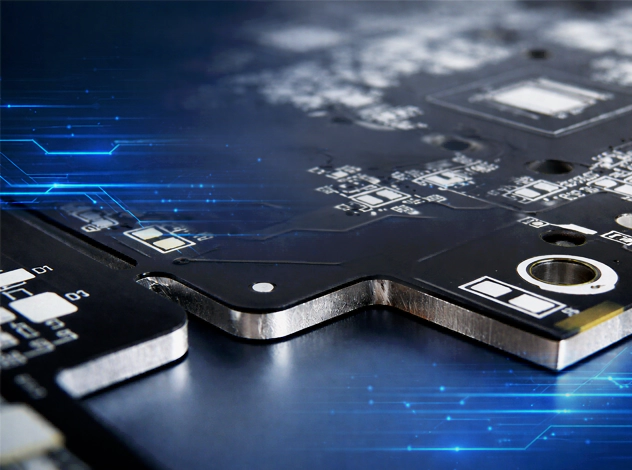


Precision Metal Core PCB Manufacturing ?
Metal core PCB—also called MCPCB or IMS—is designed for applications where heat limits reliability. By replacing standard FR-4 with an aluminum or copper substrate, MCPCBs work as built-in heat spreaders, drawing heat away from LEDs and power devices to improve stability and extend service life.
FR-4 is a proven general-purpose material, but it isn’t optimized for high-power heat dissipation. A metal core PCB pairs a metal base with a thermally conductive dielectric layer to reduce hotspots, protect components, and maintain consistent performance in demanding environments.
FastTurn delivers metal core PCB (MCPCB) manufacturing with consistent thermal performance and reliable build quality.
- DFM support to reduce risk and improve yield
- Suitable for prototypes and small-to-medium runs
- Material options: aluminum or copper core, based on thermal and cost needs


What Is a Metal Core PCB (MCPCB) ?
A metal core PCB (MCPCB)—also called an IMS (Insulated Metal Substrate) PCB—uses a metal base (typically aluminum or copper) instead of FR-4. The metal core provides rigidity and works as a built-in heat spreader, moving heat away from power components to improve reliability.
Typical MCPCB Stackup
- Copper circuit layer
- Thermally conductive dielectric layer (electrical isolation + heat transfer)
- Metal substrate (aluminum or copper)
MCPCB vs. FR-4
FR-4 is a general-purpose PCB material. MCPCBs are used when thermal performance is critical, helping reduce hotspots and support stable operation in high-power designs.
MCPCB vs. Aluminum PCB
An aluminum PCB is one type of MCPCB. “MCPCB” is the broader category; “aluminum PCB” means explicitly the core material is aluminum.
Metal Core PCB Capabilities
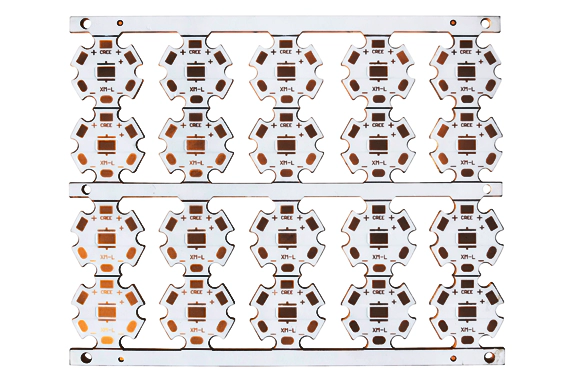
FastTurn supports metal-core PCB (MCPCB/IMS) builds for thermal-management applications, with flexible options for materials, layer configurations, and manufacturing controls. Below are the most common capability areas customers specify when sourcing a metal core PCB manufacturer for prototypes and production.
- Metal Core PCB Material Options
Choose the right metal core PCB material based on thermal targets, mechanical requirements, and cost:
- Aluminum Core MCPCB
The most widely used cost-effective heat-dissipation method is standard in LED modules and many power designs. - Copper Core MCPCB
Higher thermal performance for demanding power density applications (typically higher material cost and weight). - Steel Core MCPCB (Specialty)
Used when rigidity or specific mechanical characteristics are required; generally has lower thermal conductivity than aluminum/copper.
- Layer Configurations / Board Types
We can support MCPCB structures commonly requested in thermal PCB programs:
- Single-Layer MCPCB
Ideal for LED drivers and many power control layouts where heat spreading is the primary requirement. - Double-Layer / Double-Sided MCPCB
Used when routing density increases or when design constraints require additional layers. - Multilayer MCPCB
Available for advanced designs that require higher interconnect density alongside thermal performance (subject to project review). - COB MCPCB
Chip-on-board layouts for LED and thermally sensitive assemblies (available upon request if your design requires them).
Our MCPCB Manufacturing Process
FastTurn follows a controlled workflow to ensure metal core PCB (MCPCB / IMS) builds meet thermal, mechanical, and electrical requirements. From the first file review to final shipment, each step is designed to improve manufacturability, reduce risk, and deliver consistent quality for prototypes and production.
- File Review & DFM (Thermal + Manufacturability)
We review Gerbers, drawings, and requirements to confirm stackup intent, thermal path design, isolation clearances, and build feasibility.
- Material Confirmation (Metal Base + Dielectric)
We align your metal-core PCB material selection—aluminum or copper core—with your dielectric requirements for thermal conductivity and electrical isolation.
- Imaging & Etching (Circuit Layer Formation)
Copper circuitry is defined with controlled imaging and etching to meet routing accuracy and critical dimensions.
- Bonding to Metal Substrate (Lamination / Pressing)
The circuit layer is bonded to the metal base through the dielectric layer using controlled bonding conditions to support stable thermal transfer and structural integrity.
- Surface Finish & Solder Mask
Surface finish and solder mask are applied per project requirements to support assembly performance and durability.
- Inspection & Electrical Test
Boards undergo visual inspection and electrical testing to verify opens/shorts and ensure build quality before release.


Testing & Inspection for Thermal Reliability
FastTurn builds metal-core PCBs (MCPCBs/IMS) for applications where heat directly impacts performance and service life. To protect thermal reliability, we apply inspection and test controls throughout fabrication—verifying electrical integrity, critical dimensions, and build consistency before shipment.
This approach helps reduce field failures caused by opens/shorts, poor bonding, or mechanical fit issues that can compromise heat transfer and long-term stability.
Inspection & Test Coverage
- Electrical Testing
Confirms circuit continuity and verifies there are no shorts—standard for reliable metal core PCB manufacturing. - Visual Inspection
Checks trace quality, solder mask coverage, surface finish condition, and artistry to ensure clean, assembly-ready boards. - Dimensional Verification
Validates board outline, mounting holes, and mechanical features critical for heatsink contact, enclosure fit, and repeatable assembly. - Bonding / Lamination Quality Checks
Process checks focused on the dielectric-to-metal bonding interface to support stable heat transfer and consistent build results. - Surface Finish Verification
Confirms finish uniformity and adherence to project requirements for solderability and durability.
Quality & Certifications
Quality at Every Step
- Comprehensive Quality Control System
- Inspection & Electrical Testing
- Controlled Material & Bonding Processes
- Traceability & Documentation
- Continuous Improvement Practices
Certifications
- ISO 9001:2015 – Quality Management Systems
- ISO 13485:2016 – Medical Device Manufacturing
- IPC-A-610 & J-STD-001 – Assembly Workmanship Standards
- RoHS / Lead-Free Compliance – Environmental Regulations
- ANSI/ESD S20.20 – ESD Protection
- SMTA Membership – Industry Standards Participation
Our portfolio
Our portfolio features metal core PCB (MCPCB/IMS) builds for thermal-critical applications, including aluminum- and copper-core designs. Each build reflects consistent artistry, clean finishes, and reliable performance from prototype to production.


Prototyping to Production
FastTurn supports the full lifecycle of metal core PCB (MCPCB / IMS) projects—from fast-turn prototypes to scalable production—so you can validate thermal performance early and transition to stable manufacturing without changing suppliers or processes.
Our metal core PCB manufacturing workflow is built for consistency. Engineering DFM review, material confirmation (aluminum or copper core), and controlled fabrication steps help reduce respins and maintain repeatable build quality as volumes increase.
Our Agile Manufacturing Model Supports
- NPI (New Product Introduction) Programs
- Design Validation with Rapid Feedback
- Prototype and Small-to-Medium Production Volumes
- Accelerated Time-to-Market
- Manufacturability Optimization


Industries & Applications We Support
Industries & Applications We Support
Industries & Applications
- LED Lighting & Displays
- Power Electronics
- Automotive Electronics & Lighting
- Industrial & Automation
- Telecom & Communications Power
- Medical & Life Sciences
Why FastTurn PCB?

Diverse Industry Expertise
We support industrial, medical, energy, communications, and other high-reliability industries, delivering through-hole PCB assembly and mixed-technology PCBA for applications with demanding mechanical and environmental requirements.

End-to-End PCB Assembly Solutions
FastTurn provides end-to-end PCB assembly services under one controlled workflow. Early DFM involvement helps reduce risk and enables a smooth transition from fast-turn prototypes to scalable production.

Turnkey Assembly Services
Our turnkey PCB assembly services include component sourcing, SMT and through-hole assembly, testing, and final integration—simplifying supply chains and improving execution consistency.

Advanced Manufacturing Capabilities
We support complex PCB assemblies through controlled processes, skilled technicians, and flexible assembly lines suited for high-mix and low-to-medium volume production.

Comprehensive Testing & Quality Control
Quality is embedded throughout our PCB assembly process, with inspection and testing methods applied to detect issues early and ensure long-term reliability.

Efficient Lead Times
Streamlined workflows and responsive engineering enable fast prototype turnaround and reliable production schedules without compromising assembly quality.
Inside Our Facilities


FAQ
A metal core PCB (MCPCB)—also called an IMS PCB—uses a metal base (typically aluminum or copper) instead of FR-4. The metal core acts as a heat spreader, moving heat away from power components and improving reliability.
An aluminum-core PCB is a type of metal-core PCB. “MCPCB” is the broader category (aluminum- or copper-core).
FR-4 is a general-purpose PCB material. Metal core PCBs are chosen when thermal performance is critical, helping reduce hotspots in high-power designs.
A standard metal core PCB stackup is:
Copper circuit layer → thermally conductive dielectric layer → metal substrate (aluminum or copper).
Most projects use an aluminum core for cost-effective thermal performance. A copper core is used when higher thermal performance is required (typically at a higher cost/weight).
Thickness depends on the metal base, dielectric layer, and copper thickness. Share your requirements, and we’ll recommend a practical build.
Many MCPCBs are single-layer, especially for LED and power boards. Double-layer or multilayer MCPCBs are available when routing and design requirements demand it.
Looking for an expert quick-turn to turnkey PCB solution?
FastTurn PCB specializes in higher layer count PCBs, quick-turn manufacturing, HDI structures, blind and buried vias, as well as controlled impedance and precision fabrication processes.