

Aluminum PCB Manufacturer
High-performance aluminum PCB boards built for efficient heat dissipation and long-term reliability. Using controlled fabrication processes, thermal-focused materials, and IPC-aligned quality standards, we deliver aluminum PCBs for LED lighting, power electronics, and enclosure-based “aluminum box PCB” applications.
- All uploads are secure and confidential.
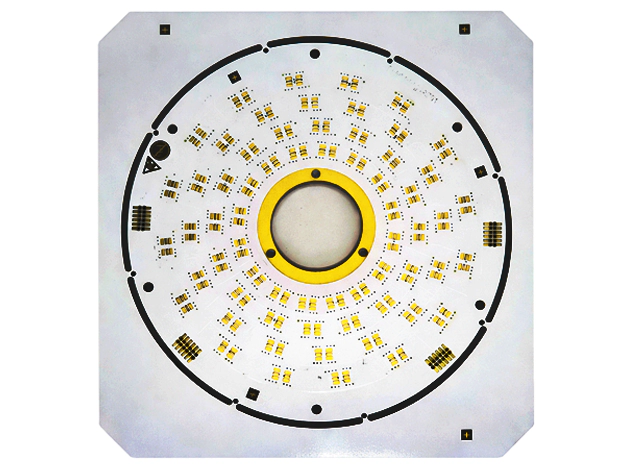


Precision Aluminum PCB Manufacturing?
Aluminum PCBs are ideal for products that need efficient heat dissipation and stable performance in higher-temperature environments. By moving heat away from critical components, an aluminum PCB board helps reduce operating temperature and improve long-term reliability—especially in LED and power designs where standard FR-4 may fall short.
FastTurn PCB provides precision aluminum PCB manufacturing for LED modules, power supplies, and automotive lighting/electronics, supporting both prototypes and small-to-medium production. Our workflow combines DFM review and controlled fabrication to deliver consistent thermal performance and dependable build quality.
What FastTurn delivers
- Thermal-focused aluminum PCB boards for heat-sensitive designs
- Prototype to small/medium run support
- DFM review to reduce risk and improve yield


What Is an Aluminum PCB ?
An aluminum PCB (also called an aluminum PCB board or aluminum-base PCB) is a thermal-management circuit board built on an aluminum substrate. It typically consists of a copper circuit layer, a thermally conductive but electrically insulating dielectric layer, and an aluminum base that helps move heat away from components more efficiently than standard FR-4.
Because aluminum cores quickly spread and dissipate heat, aluminum PCB boards are widely used in designs where temperature control directly impacts performance and lifespan. They’re especially common in LED lighting, power supplies, and drivers, and automotive electronics, where reducing hot spots helps improve stability and long-term reliability.
Most aluminum PCBs are single-layer designs optimized for cost-effective heat transfer. At the same time, some applications use double-layer or specialized structures when routing flexibility or higher power density is required. At FastTurn PCB, we manufacture aluminum PCBs with controlled processes and engineering review to ensure consistent thermal performance from prototype builds to small-to-medium production runs.
Common Types of Aluminum PCBs
Aluminum PCBs come in several common structures, each designed to balance thermal performance, routing needs, and cost. Choosing the right type depends on how much heat your design generates, how complex the circuitry is, and how the board will be mounted in the final product.
- Single-Layer Aluminum PCB
Single-layer aluminum PCBs are the most widely used option for thermal management. With one copper circuit layer on a thermally conductive dielectric over an aluminum base, they provide efficient heat spreading for LED boards, power drivers, and high-current modules where routing is relatively simple.
- Double-Layer Aluminum PCB
Double-layer aluminum PCBs add a circuit layer to support more complex routing and circuit integration while still prioritizing heat dissipation. They are used when designs need extra traces or component density but still require the thermal benefits of an aluminum substrate.
- Metal-Core PCB (MCPCB)
Metal-core PCBs (often grouped under MCPCBs) include aluminum-core and, in higher-power scenarios, copper-core options. These builds are selected when the application demands stronger heat transfer, improved mechanical stability, or higher power density—common in industrial power electronics and automotive systems.
- Hybrid / Multilayer Aluminum Structures
For specific high-power designs, hybrid structures combine thermal layers with FR-4 or other materials to achieve both thermal performance and greater circuit complexity. These solutions are often used when engineers need more routing layers than standard aluminum PCB constructions typically allow, while still maintaining a controlled thermal path.

Aluminum PCB Capabilities

FastTurn PCB builds aluminum PCB boards for heat-sensitive designs where thermal stability and long-term reliability matter. Our aluminum PCB capability set is designed to support both fast-turn prototypes and small-to-medium production with consistent process control and predictable results.
- Material Options
- Aluminum core (Domestic 1060)
- Copper core
- FR-4 covering / hybrid structures
- Thermal Conductivity
Multiple dielectric options available for different heat loads (e.g., 1.0 / 1.5 / 2.0 / 3.0 W/(m·K))
- Copper Thickness / Board Thickness
- Copper: options available based on current handling and thermal needs (e.g., 1–4 oz)
- Board thickness: build options available for mechanical strength and assembly requirements (e.g., 0.4–3.2 mm)
- Surface Finishes
ENIG (Immersion Gold), OSP, Hard Gold, Immersion Silver, ENEPIG
- Solder Mask & Legend
- Solder mask colors: Green, Red, Yellow, Blue, White, Black, Purple, Matte Black, Matte Green
- Silkscreen: White, Black
- Via Process
Tenting vias, Plugged vias, Vias not covered.

Testing & Inspection for Reliable Performance
FastTurn PCB delivers reliable, repeatable aluminum PCB builds through disciplined inspection and verification. From a single aluminum PCB board prototype to production runs of aluminum PCB boards, we validate artistry, critical features, and build accuracy before shipment to support stable thermal performance.
Testing and inspection are built into our aluminum PCB manufacturing process and selected based on design complexity and end-use requirements. This structured approach helps improve yield, reduce rework, and minimize field failures in heat-sensitive applications.
Testing & Inspection Capabilities
- Electrical Testing (E-Test)
Verifies connectivity by detecting opens and shorts to ensure the aluminum PCB meets netlist requirements. - Automated Optical Inspection (AOI)
Checks critical fabrication features and artistry consistency to reduce escape defects. - Visual Inspection
Confirms surface finish quality, solder mask integrity, markings, and overall appearance before shipment. - Dimensional & Critical Feature Verification
Confirms key build requirements such as board outline, hole locations, and tolerance-sensitive features . - Microsection Analysis
Cross-section validation for layer structure and material interface quality when tighter verification is needed. - Solderability / Surface Finish Verification
Evaluates finish integrity to support smoother assembly performance in downstream PCBA. - Documentation & Traceability
Supports consistent quality control with inspection records and builds documentation for production programs.
Quality & Certifications
Quality at Every Step
- Comprehensive Quality Control Systems
- Advanced Testing Platforms
- IPC-A-610 & J-STD-001 Trained Technicians
- Traceability & Documentation
- Continuous Improvement Practices
Certifications
- ISO 9001:2015 – Quality Management Systems
- ISO 13485:2016 – Medical Device Manufacturing
- IPC-A-610 & J-STD-001 – Assembly Workmanship Standards
- RoHS / Lead-Free Compliance – Environmental Regulations
- ANSI/ESD S20.20 – ESD Protection
- SMTA Membership – Industry Standards Participation
Our portfolio
Our portfolio features aluminum PCB boards built for heat-sensitive applications, including LED modules, power drivers, and automotive lighting. Each aluminum PCB reflects consistent artistry and reliable thermal performance across prototypes and production runs.


Prototyping to Production
FastTurn PCB supports the full lifecycle of aluminum PCB manufacturing from fast-turn prototypes to scalable production, so you can validate thermal performance early and transition into repeatable builds with confidence. Whether you need one aluminum PCB board for engineering verification or for production runs of aluminum PCB boards, our workflow is designed to keep materials, process controls, and quality checks consistent as volume scales up.
Our Agile Manufacturing Model Supports
- NPI (New Product Introduction) Programs
Structured support for early designs and production ramp-up. - Rapid Design Validation
DFM feedback and manufacturability guidance to reduce iteration cycles. - High-Mix, Low-Volume to Small/Medium Runs
Flexible production planning to match changing demand and complexity. - Accelerated Time-to-Market
Streamlined quoting and fabrication workflows to shorten lead times. - Manufacturability Optimization
Continuous improvement focused on yield, consistency, and long-term reliability for thermal-critical builds.


Industries & Applications We Support
Industries & Applications We Support
Industries & Applications
- LED Lighting
- Power Electronics
- Automotive Electronics
- Industrial & Automation
- Communications Equipment
- Medical & Scientific Devices
Why FastTurn PCB?

Diverse Industry Expertise
We support industrial, medical, energy, communications, and other high-reliability industries, delivering through-hole PCB assembly and mixed-technology PCBA for applications with demanding mechanical and environmental requirements.

End-to-End PCB Assembly Solutions
FastTurn provides end-to-end PCB assembly services under one controlled workflow. Early DFM involvement helps reduce risk and enables a smooth transition from fast-turn prototypes to scalable production.

Turnkey Assembly Services
Our turnkey PCB assembly services include component sourcing, SMT and through-hole assembly, testing, and final integration—simplifying supply chains and improving execution consistency.

Advanced Manufacturing Capabilities
We support complex PCB assemblies through controlled processes, skilled technicians, and flexible assembly lines suited for high-mix and low-to-medium volume production.

Comprehensive Testing & Quality Control
Quality is embedded throughout our PCB assembly process, with inspection and testing methods applied to detect issues early and ensure long-term reliability.

Efficient Lead Times
Streamlined workflows and responsive engineering enable fast prototype turnaround and reliable production schedules without compromising assembly quality.
Inside Our Facilities


FAQ
Through-hole PCB assembly inserts component leads into drilled holes on the PCB, creating stronger mechanical bonds than SMT, which mounts components directly onto the surface. This makes through-hole assembly ideal for applications requiring durability and mechanical stability.
Flex PCBs are primarily made from polyimide (PI) or polyester (PET) substrates with copper foil layers. We also use adhesiveless laminates for high-reliability applications. Coverlays, stiffeners (FR4 or stainless steel), and surface finishes (ENIG, OSP) are added depending on the design.
Lead times depend on complexity and quantity:
- Prototype Flex PCBs: 3–7 business days
- Production Runs: 7–20 business days
Expedited options are available for urgent projects — contact us for a custom quote.
Lead times depend on complexity and quantity:
- Prototype Flex PCBs: 3–7 business days
- Production Runs: 7–20 business days
Expedited options are available for urgent projects — contact us for a custom quote.
Lead times depend on complexity and quantity:
- Prototype Flex PCBs: 3–7 business days
- Production Runs: 7–20 business days
Expedited options are available for urgent projects — contact us for a custom quote.
Lead times depend on complexity and quantity:
- Prototype Flex PCBs: 3–7 business days
- Production Runs: 7–20 business days
Expedited options are available for urgent projects — contact us for a custom quote.
Looking for an expert quick-turn to turnkey PCB solution?
FastTurn PCB specializes in higher layer count PCBs, quick-turn manufacturing, HDI structures, blind and buried vias, as well as controlled impedance and precision fabrication processes.